When people believe in you, you start believing in yourself.
I grew up not being believed in — my skills and abilities and also my innate wisdom were overlooked; considered odd — and I consequently learnt from a very young age to abandon myself to fit in and be fed.
I am not a victim to this because I also know the wound is the gift.
So my life’s calling, and my ultimate answering to it, has been to value people and help them heal enough to believe in themselves again.
I have found in life that there are two times where people get abandoned in the type of society we now live in where attention spans are diminished and judgement trumps trust: when at our absolute rock bottom having lost the ability to don the masks of an expected norm, and when in our blissful joy living in alignment with our purpose and meaning.
There are always those champions in life who hold you in support and believe in you at both ends of the spectrum — these are your people; hold onto them … the ones who only hang out in the middle zones only erode the belief in yourself you have worked so hard at regaining.
The loneliest of people aren’t those who have no one around, they are the ones surrounded by people who don’t share values and who expect you to show up in service of who they need you to be.
As Michael Mead says, “The calling keeps calling.”
It is never too late and you are never too old to become who you were born to be. Depression, addiction, anxiety, stress … to name only a few afflictions of this world we live in … are the silent killers that need to be witnessed and brought into the light by those willing to go into the dark.
I have found that when life is so hard I have lost the capacity to help myself, I go buy a meal or a blanket for a homeless person or pay for street people to spend a night in a shelter. This is my medicine—an unwitting and relatively minor altruism and the one that has had the power to keep me going until I believe in myself again.
And then I must dance … because dark and light have to be navigated in equal measure for the psyche to find true harmony.
People often ask how I got from the 60-hour work week, shackled to a corporate desk in Investment Banking, to the fluidity and flexibility of a multi-faceted therapist, coach and guide.
In surrender, I reply … on my knees, with broken heart and shattered dreams. And not just the once.
For decades I did what I was meant to do to fit the societal construct of a productive adult contributing to a broken world. Nobody had versed me in the art of creative choices, the trust in intuition, and the capacity to follow my soul in life or in love.
We often think doing the work, the training, the emotional labour, means that we will be more resilient at times of challenge. But it’s often not true.
It is my role to guide you through the crises, that will ultimately bring growth and development, rather than numb you with more layers of bullshit just to temporarily help you ‘fit in’ with the essentially dysfunctional society in which you exist. Existential distress does not equate to mental disease; it means there is an inner tension pushing you through another birthing into a new way of existence. It is a calling to the you who needs to unravel in order to be rewoven.
Through the blend of modalities that I show up with in service to your wellbeing, there is an un-layering that occurs to reveal your values and roles, or bring you to a place of balance from where you can better develop those values in order to find belonging through authenticity rather than through merely adopting the values of those around you and ultimately adapting to a system that doesn’t resonate with your true need to find meaning.
It is important to find the core strength to stand out rather than fit in; to add rather than adapt; to live your own life rather than exist in others’. You don’t come into the world; you come out of it.
As a nomad on life’s landscapes I have developed the skills and wisdom to guide you to a deep exploration of who you are, what your gifts are and how to live your truth and purpose into the world with curiosity and compassion.
People call me courageous because of how I approach life. The word courage comes from cor meaning heart so, yes, this is a word I live into the world … one day at a time.
I blend my studies with my experience and I bring a deep wisdom, tempered with ignorance, into the world.
I invite you to explore your inner world like a true adventurer.
I am an energetic accumulation of my life force, my experiences, my research, my studies, my connections and my family tree; I am you in me and I am me in you.
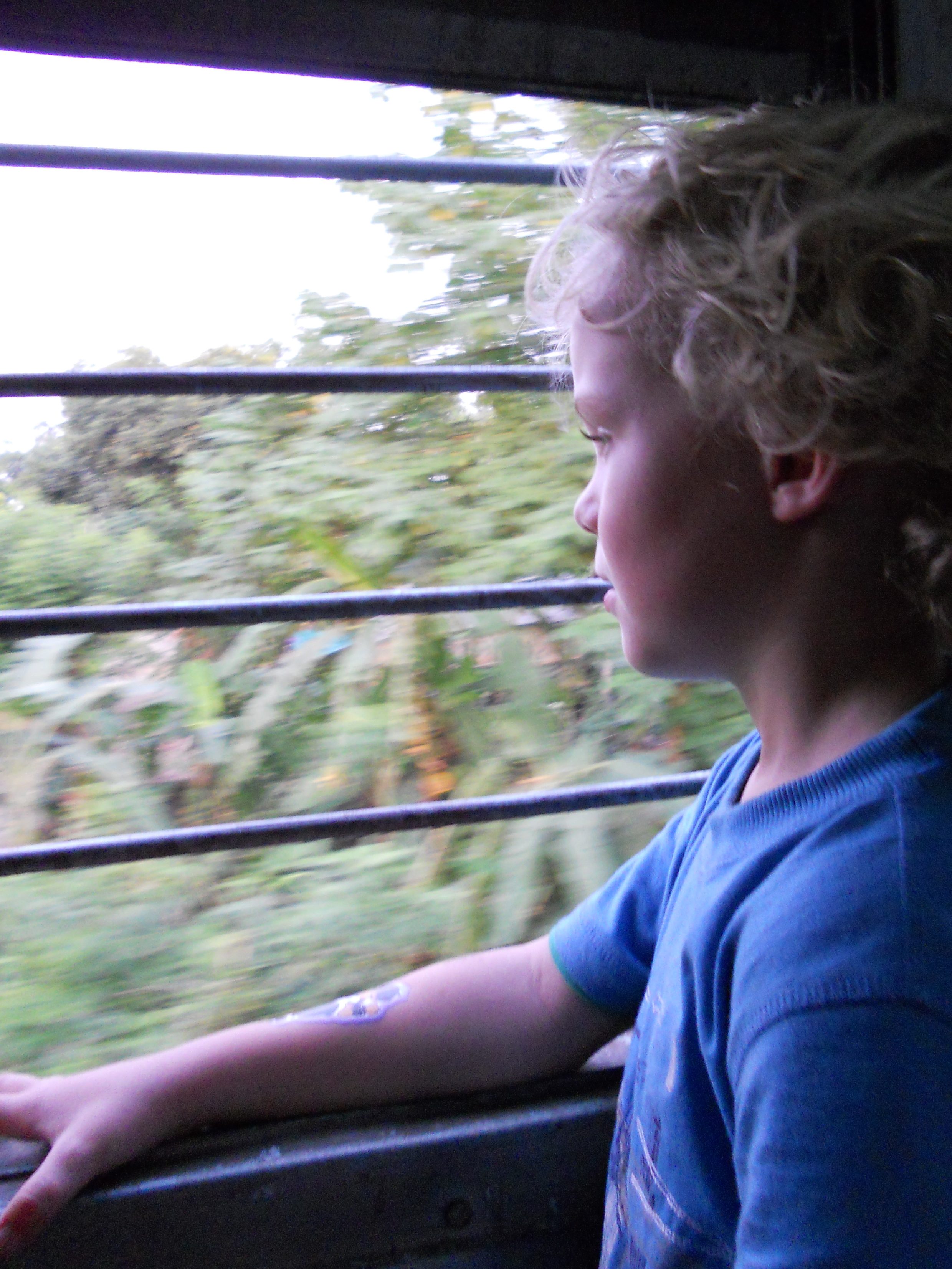
“What the hell is going on out there?” I asked a fellow passenger in the quickening darkness of a train carriage at our first stop en route to the north east of the Indian sub-continent. We had arrived in Siliguri from Kalimpong to an energy of agitation and fast-spreading rumours of an imminent strike. Advised to get to a safer place, I had picked the tiny remote village of Madahirat where I hoped to take Nic on an elephant safari through their local national park, Jaldaphara Wildlife Sanctuary. The subject of my demand stared back at me as he sliced his finger across his throat. Before I could take it personally he explained in Hinglish, “One woman dead. Head off. The cause of passengers leaping and running from their carriages, cameras and camcorders at the ready, was the macabre fate of a woman who had slipped getting onto the train at our very first stop. Decapitated.
As the lights went on in the carriage, the crowd outside, filled with gore from their amateur filming, became a mob as they turned their attention on something to release their restless horror. That something was me. And as more people gathered, the shouting began. Banging on the side of the carriage. Shrieking for me to get off the train. A riot had begun.
I kept my eyes averted, trying to ignore the attention, fixing my gaze on my lap where I was holding Nic’s head, stroking his hair, keeping him out of sight while keeping him emotionally safe. As I began to gather my belongings, someone bolted the doors.
There was just enough English on my side of fate to be told not to comply; not to move; not to respond … no glass in the carriage windows meant nothing to break and solid steel bars meant the barrier would hold. The police did eventually arrive with their sticks and moustaches to clear the mob, the dismembered body and get the train running again. Hours had passed.
By the time we arrived in Madahirat it was around midnight. I was still wide-eyed and shaky carrying a sleeping child under one arm, my backpack on my back, his backpack on my front and various other provisions under my other arm. A worried Mithan Das, proprietor of Hotel Relax, a hole-in-the-wall style hotel with roll-up garage door frontage was waiting to take the load off; I had kept him on the phone for an hour during the riot so at least someone knew where we were if we were ripped from our seats, each other, and even ourselves.
A day later the entire area erupted into a situation of strikes, riots, mob violence and general unrest as we were forced to immediately go into lockdown in this grungy homestay in a no-horse town. The year was 2010.
Fast forward to fifteen years later, I found myself as a solo passenger in a getaway taxi from 4.30am gunning it for eleven hours from Bir Billing to Delhi. Airport closures and missile strikes in the north west of India and a flight out the following week meant I had to move fast or risk being stranded in the mountains. On previous trips I have longed for fate to play the hand of keeping me in India indefinitely but, seven months away (eighteen in total) and already mentally and emotionally prepared to be departing two weeks later, the threats and speculations of war fuelled a mama bear motivation to see my son. I became fixated on getting the fuck out as soon as possible.
An astrologer told me after the incident fifteen years ago that India would always throw up monumental issues for me and—hoo-boy!—does she always deliver … be that on Indian soil, in the form of geopolitics, or back home, in the form of home and relational dynamics, as a consequence of my being in India.
A friend in Bir Billing in the foothills at the Himalaya told me that India is cuffed on one side by Bangladesh and on the other by Pakistan.
Fifteen years ago Nic and I unwittingly crossed into an area of conflict that included the derailment of trains and the fatal stabbings of foreigners as riots tore through the north east cuff in a fight for sovereignty in the area known as Ghorkaland to those seeking independence from India. This time I was also in a small northern mountain village on the opposite side of the continent where the other cuff was fighting again in their decades-long grab for Kashmir and a crack down on terrorism. In 2010 the conflict was very localised and we were right in it. The police commissioner, acting on behalf of the British Embassy in service to our protection, arrived at our door to instruct us to not even think of getting on a train or, for that matter, to go more than a few hundred meters from the homestay. “You will be at the mercy of brutal mob murder if you venture out”, he added. There was no malice, just a need to convey the severity of the situation and ensure I understood this was not a matter to overcome.
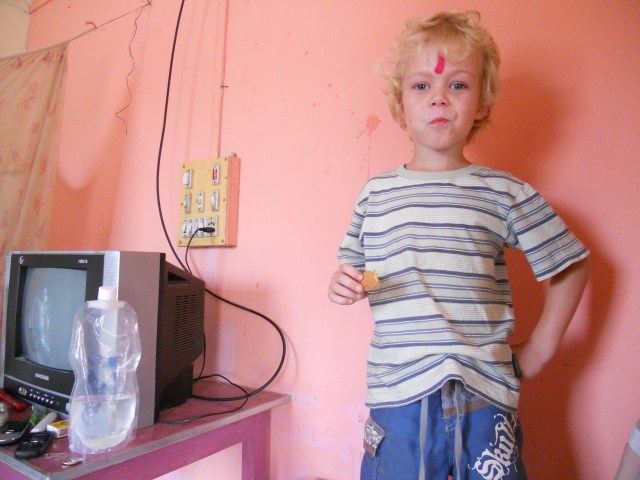
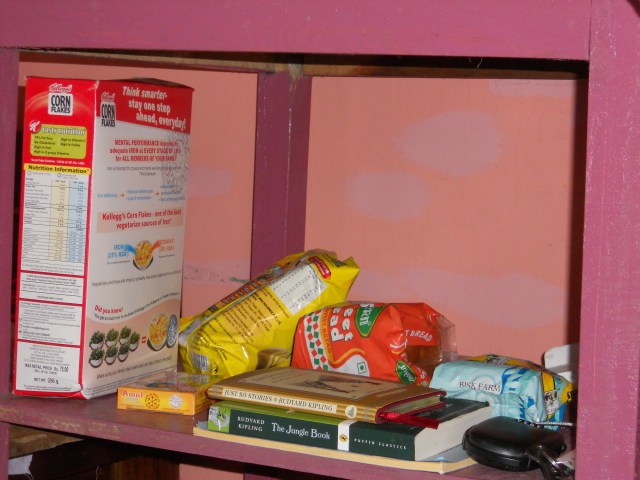
In this current situation I was not in immediate danger, bar the possibility of a misguided missile going off course en route to one of the many military bases in the area. Both times transport was an issue. Last time train stations were being shut down, this time all the airports in the north and west were closed—the terrorists were using civilian aircraft as a shield to shoot missiles that India couldn’t bring down without the risk of hitting said planes. Most significantly though is that both times my location was geographically on the wrong side of the conflict putting the zone of danger between where I was and where my flight was. In 2010, several days after we went into lockdown, our host rushed in saying we had 20 minutes to pack; a jeep was coming to smuggle us out. The rebels had declared a 3-hour moratorium for people to go out for provisions. It would take approximately three hours to get over the bridge that marked the boundary and if there were any glitches along the way, we would be in severe danger and in violation of the curfew. If anyone stopped us, he added, we would have to pretend I had a medical emergency. I doubled over and cried … briefly … stood up, flexed, wiped my eyes … pulled out my geranium moisturiser for these emotional crises … and then packed at breakneck speed while Nic listened and sang along to songs on his iPod, munching on the remains of the dry cornflakes, crackers and processed cheese we had subsisted on for days, the remains of the red dot on his forehead from the morning’s pooja, smudged across his eyebrows.
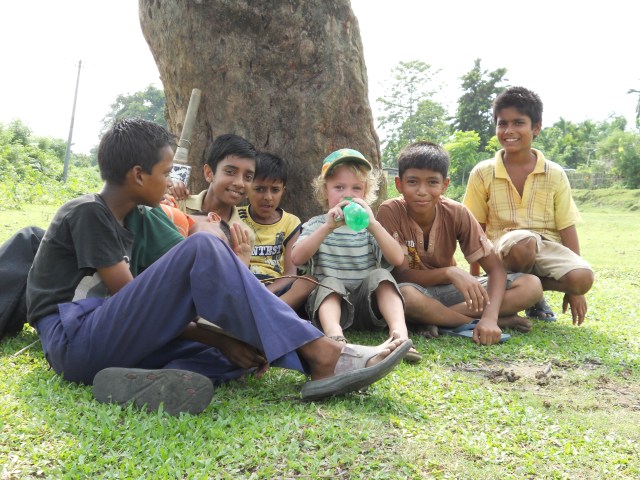
The delight of travelling with a 4-year-old is that I had to get creative. With a child it’s important to keep them informed whilst keeping them safe—physically as well as emotionally. And I got to perceive the reality of each moment through his eyes whilst managing my anxiety as a separate monster that in each moment was only a reality of potential threat rather than an actual threat. The reality was that we were stuck; the reality was that there was violence and murder close to but not in our tiny village; the reality was that we could play in the park and Nic could play cricket with the village boys; the reality was that we had an ancient TV that played Tom & Jerry and Nic had an iPod with hours of stories; the reality was that we were still mostly on a superb adventure isolated from the rest of the world.
This experience fifteen years ago shed a different light on my recent evacuation drama from missile strikes and the threat of war between Pakistan and India. It helped me keep perspective. It gave containment in a situation with zero support. But I was still afraid.
In a world where emotions get labelled negative and positive, and false positivity seems to be lauded over pragmatic and oftentimes necessary negativity, I get exhausted by people accusing others of choosing to live in fear … when fear is the exact emotion one has to live in when needing to react to a terrifying situation. Fear has been my friend. Without fear I would have remained in my marriage; without fear I would have been too trusting in too many situations; without fear I would have boarded a train to imminent death; without fear I would never be motivated to take action out of harm’s way for myself or my child; without fear I would not be guided to make decisions based on gut rather than brain. Every emotion is a tool in our toolbox and the key is not to throw tools out when they’re not working for something but instead learn their purpose and function within their range of benefit to the task at hand.
India stimulates every emotion in my being and shakes them all loose. I am in Cape Town now to calm my sensory overload and prepare for another departure later this year … somewhere other than India this time. India is always and forever my growth point, but I just feel I have had enough growing for now.
I have been trying to find the seed to write as I have been reluctant/resistant to tell my stories and reveal all the mucky truths … still that fearful little girl inside not wanting to invite the wrath of volatile family members who offer nothing without conditions … so I have been trying to write everything apart from what is trying to be written.
There are opposing voices in my head—one warning me the just be quiet because of the impact the truth has, and the other down on its knees begging for this truth to be told. Truth isn’t the same as facts. Truth is something deeper.
After an episode of coercive manipulation last year, I no longer feel the need to fawn or fight as I lean into what Anne Lamott says: “You own everything that happened to you. Tell your stories. If people wanted you to write warmly about them, they should have behaved better”.
I can’t tell a powerful story if I’m afraid of hurting people—writing from a place of fear is never a good way to proceed. My first obligation as I forge ahead is to the truth of my story and that means not censoring myself.
Some stories need to be told, and while the telling may come with some fallout, my compulsion to share my own story is because it helps others feel less alone; those who need to be reminded that in a world of eight billion people, it is inevitable that there is going to be an awful lot of shared experience and, although we all have our unique interpretations of events, we are not unique in our struggles. We mostly just need help getting to the other side of them.
This is what my work is all about—not transcending anything but simply being my authentic dark and twisty self so that I can hold those parts of other wounded souls. I am not into false positivity; I am into real hard life stuff … the cracks and breaks that guide the way into the gifts that each one of us has.
My lifelong studies, self development and spiritual growth have led me to the gifts I was born with—not to tell people to let go of the past and leave the pain alone but to sit with them in their past and in their pain. It is only in going into the dark that one can one day come out into the light once more.
My grandmother, Diana Mellor, was born in Mussoorie, India. Activist, artist, storyteller, writer and something of an enigma and inspiration, I felt the way she was also an outlier like I was meant that perhaps we both came from another world. My father—her son—slipped between convention and this other dimension. Our curiosity, humour and mischievous nature run like a thread from her down the paternal line and continue through my own son. In my memory, she was one of those beings who always glowed with radiant light and I often consider her to be my real mother in terms of character traits and looks. Her silky slightly-strawberry blonde hair remained that way almost until her death in her 80s and, although I can’t claim to have kept my own grey at bay, I have her and my father’s big blue eyes that she would declare came around corners before I did.
It was once I had discarded the parts of my life and my Self that needed shedding and began to build (literally) from scratch, a new life and home that I began to fully comprehend how much of an influence her eclectic house, filled with treasures from her travels, motivated my own treasure-filled sanctuary.
In Colonial India, expats would go to the hill stations in the heat of summer and to give birth. Her Irish mother fit this demographic, hence the geography of her becoming in the world. As a judge in India in the early 1900s, her father was likely not one of the good guys and yet I do often wonder if Diana’s compassionate heart, deep wisdom and stoic acts of courage were a result of good modelling or bad; whether she became who she was because her father too was against the system of oppression or if who she became was in fact an act of rebellion. My father too was something of an outlier, acting perhaps unwitting in alignment with his mother’s core values despite them being somewhat unusual in the political climate of South Africa in the 70s and 80s. This is the genetic line I follow and one that has created a chasm between myself and a family that cast me out for my perspectives, my diversity and my differences.
How this relates to where I am right now and the way I choose to live my life—now that I have unshackled myself from the structures that kept me bound for most of my life—is the polyamory I am currently engaged in. It’s not what you think … let me explain.
Diana would dress up as a gypsy at our birthday parties and tell our fortunes, something quite intriguing in the societal construct of the 70s. In my memory this was a regular occurrence but I can’t actually remember if she told my fortune just the once or if it was my neurodivergent brain that held onto it for its mystery and, to a degree, a truth I would only fully unravel decades later.
When she told my fortune, she would tell me I would marry a man who rides two horses at once and I would spend my marriage stitching up his trousers. Although I am not sure I ever stitched up any trousers, both my husband and the lover I took after leaving him (ok, maybe a few more too) always had a couple of fillies to ride.
Despite this duplicitous behaviour by my then husband, I can’t help but wonder if the real cause for my divorce was in fact my own affair … with India.
Diana had, in her final years with Parkinson’s Disease, begun living in parts of her brain that transported her to the bygone era of riding on elephants through the jungles and seeing tigers. Ironically, this was when I got to know and understand her deeper and this is when the seed that would take another decade to germinate was planted in my psyche.
I hadn’t intended to travel to India—the end of the 20th century saw me in London, working in Investment Banking and way too invested in a pseudo lifestyle to follow any gurus or hippies to a land I didn’t trust for its cleanliness or safety. But the airlines had other plans. Not being able to get from Nepal to our next destination, China, from any airport other than Mumbai, I plotted a route overland from Kathmandu to Varanasi, through Bodhgaya and Agra and touching into Rajasthan before an overnight bus ride down the west of the sub continent to the airport.
I didn’t intend to stray. I unwittingly fell in love. Returning to South Africa in 2004 was preceded by a two-month pilgrimage, beginning in Mussoorie and weaving around an extraordinary number of towns, villages and cities throughout India. I didn’t find Diana’s birth record, which was the deeper intention, but I forged a deeper bond with this lover. It felt like I was cheating; the marriage couldn’t include such an intense lover. I fell deeper still in 2010—once separated from my husband—when I took my then 4-year-old backpacking for 5 weeks across the country.
After that, I sold my diamonds and my shoes and anything of value that I no longer needed, to fund tickets and travels back to arms so much more loyal than what my marriage and my subsequent lover gave me.
And I was faithful to her for over a decade. Until my gap year.
I fall in love with cities and towns and villages now like I once fell in love with men. From SriLanka in December 2023, I returned to India with resistance as though I was being forced back into a relationship with something I might have outgrown. She took me again, reluctantly at first and then I was hooked again … until I went to Nepal for a few months and decided this was definitely my greatest love.
So, no, I am not married or tethered to a man straddling horses any longer and the only stitching I am doing is the weaving of a new heart … straddling countries like lovers between whom I cannot choose.
Some people travel to find themselves, some to lose themselves. I travel to discover that which brings me to life through confronting death and adaptability. Travel wakes me up from the narcolepsy—and also the more generalised sleep—it informs me; wisens me. It opens the portal to the writer in me so that I can write out into the world that which I most need to learn … so that what needs to live through me can fill my vessel and reweave my narrative.
It’s the movement of travel that I most adore. The momentum, the dynamism … the swings and spirals to find that sweet spot of equilibrium and poise. Balance is an unnatural state—a new age erroneous desire—it alludes to a state of stagnation. Sitting at a desk in front of a window to write, the curtains are drawn on my mind. But put me next to the window on the backseat of a taxi on a bumpy, windy road under construction with an uncomfortably full bladder and an ache of hunger from a 7-day fruit fast, and I am instantly inspired.
Triggers confront me—consume me—as I am forced to work cell-by-cell on past traumas to remind myself that I am truly free and that I can finally write without fear of recrimination. I lean in deep enough to touch into the fears, the anxieties, the debilitating threats I faced of getting thrown out of home or losing custody of my child if I spoke my truth … if I shared my reality. Courage walks hand in hand with fear. I am known to overshare if given the chance.
The barrier on a bridge has been opened like a gate. A rusted reminder of mortality lies in the riverbed beneath. Giant stairways and planted beans stretch to the giant in the sky. Departing souls have easy access to high places. Also a reminder that first one must fall to rise. Death feels easy here. Heaven and hell are only as far apart as earth and sky. There is no separation, only perceived segregation. There is no ‘other’. The inner child takes the crone by the hand. They jump and skip. Heads thrown back, they laugh at the sky. The sky knows change. It is unmoved.
Houses retreat into rubble and dust, making way for a new highway. Memories of a Yangtze River trip invade my mind as people are displaced to higher ground. The road becomes like a river washing away houses … an unnatural disaster; a crime against humanity. It looks like a war zone; it’s difficult to breathe. My eyes seek attainment and attachment to the next dopamine hit. A bus with DELUXE emblazoned across its front is being worked on by two bare-chested men exposing cages of ribs. Deluxe is just another word—a branding that has no intrinsic meaning value.
I am reminded by rivers of rubbish down hillsides and in forests that there is no such thing as away. Like the tongue that keeps seeking the broken tooth, the psyche will consistently and obsessively keep seeking the wounded parts again and again. We think we can throw certain things away whilst accumulating other things when in reality everything always exists and it is simply we who are shifting in and out of the objective reality of those very things we believe we are either discarding or holding onto. So I discard words and, in deleting sentences and paragraphs, I detach also from the meaning they hold.
The silences between musical notes are what frame, contain and make the songs possible. The weft and weave of story is the same. It’s the spaces that allow the piece to breathe, that give it both life and death in non-dualistic harmony. Words are plucked and rewoven, always leaving a knot untied or that one loose thread as a reminder that nothing is ever complete or perfect.
As I learn to write again with honesty and authenticity from that fierce place in my core, I write away all the shields. And as I learn to cease the word vomit that perpetuates my narrative, I learn to re-create spaces between the words so I can steep myself in the breath of the present. I pour words on my skin like nectar until they wash away—slowly, slowly—the outer layers … until my armour can rust and fall away.
The aim is not enlightenment; the aim is truth. My voice and my silence is my message.
“There’s no place like home,” lamented Dorothy in The Wizard of Oz. But home is not a structure. Just as travel is not a place we go. Home is who we are. And travel is our innate state of being. Home is an internal longing that moves us into the flights of fancy that require no planes. And travel motivates us to question our existential homelessness. We are essentially both always home when travelling and always travelling when we are home. Because there is no such thing as away.
Traveling, in my experience, is never a linear one-dimensional trajectory into the often unknown places I at times choose randomly from a National Geographic map sent as a freebie on subscription. Travel can meet me in places so foreign yet with a familiarity that is not from here or now, but from a thread that has come unplucked from a different story of another me. I see faces in profile—people in streets, on scooters, behind a glass window of a coffee shop—and I catch myself in the motion of bracing to orientate to a Hello or Vannakam or Namaste, before I comprehend fully that I am in a foreign place where everyone has begun to take on the look of a friend from somewhere else. I forget that I am the foreign place because I am also home.
Last year I packed the conventional notion of home in a box and threw it in the recycling bin. And 6 months into my travels, I feel like home for me is that discarded plastic bottle that someone has added to several hundred other plastic bottles and turned into a fleece pullover for Patagonia. It couldn’t be more different yet is has become something useful, beautiful and has created change in its very own changing. Upcycled. It has a unique narrative and plot.
Travel should always be unresolved. Travel should leave you feeling slightly edgy, like you’re missing something … or lost … like there is an existential longing for something and, like the cookie jar, is always just out of reach. For me that missing is like the pieces of myself I leave behind so I have a reason to return one day. Or perhaps they are the pieces that no longer fit; pieces that slowly become unstuck—unhinged—and fall between cracks in the earth. Like a newly extracted tooth, there is at first a sense of loss. And then—one day, with no prior warning or noticing—the tongue no longer seeks out the old but seeks only the testing and tasting of the new.
It’s a puzzle this drive to seek but not to find; the picture never completed. Perhaps there really is no such thing as completion. Our parents lied to us. Like perfection, completion is not a destination on any map; just a fanciful place. Like Neverland.
Translation comes from the Latin, ‘borne across’. I have been borne across oceans, mountains, borders, boundaries, religions. I have lost much in the process of translation—my language, my culture, my capacity to communicate with anything close to my prior vocabulary. But I have found more than I have let go—perspective, detachment, curiosity. Because just as there is no such thing as away with travel, there is also no such thing as lost. I am always here … in perpetual arriving to be where I must be for that which is arriving to meet me too.
I plot routes. The routes plot me. I walk the same paths but they are different. I am different. Same same but different. Through moving my brain triangulates the stability that sneaks through the portal of the not knowing. My plans move like the fascia of the body; tensegrity keeps them bound as well as free.
I embark on my next delivery after an extended labour, birthing once more the now grown child who birthed me. A process towards the unfolding of this myth I call my life which is in fact a life that has me.
I am weaving again: Penelope the weaver transmuted to a weaver bird in the throes of nest building; the kind that hangs by a thread … I am following the thread that both time and life defy linearity, and all exists simultaneously in one single moment; one drop; one seed; one fallen leaf in the book of consciousness.
The first knot of the weaver’s lattice creation meets the last, which is also the first, that ties them all together in an amalgamation of existence … with that one lose thread of imperfection that can be a golden thread of a noose.
Strapping on my boots with my wings and pulling up roots like an Ent on the move, one piece of ground is no more or less important; only segregated by the ignorance of the construct of fear.
(written on the plane just before takeoff on 14/12/23)









 WELL WORTH BEING