The 5 Symbols of the Camino de Santiago, Part Five: The Scallop Shell

Symbolically the shell is from the ocean and is linked to Venus (self love). It is the so-called medal at the end of the journey once the shore is met and one is able to baptise oneself in the salt water and become new once more—like a baby, and with unconditional love for self.

The way it ties together the network of support is that its image is used as way markers along the route, marking the way through landlocked villages and cities in the hopes of—in days or weeks or months time—the pilgrim will reach the end … which is also the beginning.

It is not only an inner and outer totem of the achievement of the completion of this particular pilgrimage, it also denotes an opening of the heart and a vessel from which to gather water to drink or anoint oneself. It is also used to ask for donations of food and money.

Sometimes building self kindness can be through random acts of kindness to others. Showing someone else the way can be a guide for self awareness and more adept self trust, self love and self guidance. The notion of offering a helping hand draws attention to the focus on the work I do with my hands and how that reflects on how to give—but not too much of myself so as to not become depleted—and, with the same open hand, to receive what I need from others.

The lines on the shell are known to represent the different routes taken by the pilgrims so, having this as a source, we can trace our different narratives with the outlook that there are many pathways to the same destination and the goal is in the experience itself. Being open and aware to the needs of others is the beginning of a journey home to self.

Questions to ask yourself:

  • How did I stay open and flexible to changes in the direction my day took?
  • What are the inner signals of courage I can pay more attention to?
  • How did I engage with and harmonise giving and receiving?

The end of one journey is always only the beginning of something else so there can never be any expectation of finality. Life is only what you can hold in the Scallop Shell.

On this pilgrimage, because I am walking to raise awareness for mental health and will be intentionally working with people who approach me for coaching, meditation, therapies etc, I will hang a donation box from my backpack with a QR code that pilgrims can scan to access my socials, the work I do and the cause I am walking for. This is aligned to the scallop shell which can also be used as a begging bowl and I am doing this as a way to break down my ego as I open myself to receiving donations from strangers like a nun. 

You can follow, support and share my Walking for Mental Health fundraising campaign on BackaBuddy. All my socials can be found on LinkTree.

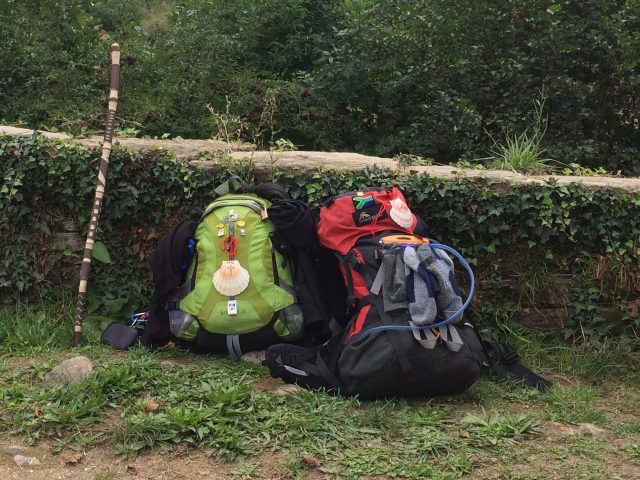
The 5 Symbols of the Camino de Santiago, Part One: The Backpack

As I embark on my most challenging pilgrimage, 1,000km on the Camino de Santiago in Spain, Walking for Mental Health, I am drawn back to reflect once more on the symbols of The Way that I have previously walked with.

The first symbol is the most important for me as it indicates the strategic part of the planning phase as I consider what to pack … adding and then eliminating … ruminating and deliberating … trying to envisage the climate, the landscape, the skin feel and mostly—perhaps obviously—the weight vs the comfort of choice.

If a backpack is too full, the physical body will be strained over capacity and the mind will be less focused on the path ahead as a consequence of the pain. Carrying an extra weight on one’s shoulders has become normalised and it’s common for people—adults, children, corporates, healers—to be brought to their knees by this weight before asking for support. Equally, the journey can be hindered by too light a pack as a result of not paying enough attention to the necessary items one needs to carry on a journey; this could also indicate a—conscious or unconscious—negation of certain personal needs and basic requirements for comfort and health.

We all tend to accumulate too much, often out of fear and death denial; a habit that is hard to break and one that ultimately results in being unwittingly burdened with more than we can carry. It’s important to see what and who lies beneath the layers we have built around ourselves and the burdens we have chosen to carry, and then to create new habits to do with shedding rather than accumulating.

To strip down on an emotional, physical and mental level takes courage because it shows us our authenticity and the corresponding vulnerabilities. By stripping down I don’t mean full renunciation; I refer to discernment around needs according to values and a slow un-layering in line with each person’s capacity and desire for transformation.

Questions to ask yourself:

  • What am I carrying today that may not be mine and/or what is the impact for me?
  • What can I remove from my backpack, and who, if relevant, can I give it to?
  • What’s essential that I might add or that would be worthwhile adding to my backpack for now?

Observations:

  • Awaken your ability to recognise when, how, where and for whom you may be over-burdening yourself. 
  • Build your capacity to feel into how your whole system is responding to the weight you are—intentionally or unintentionally—carrying on a physical, mental and/or emotional level.
  • Look at what doesn’t need to be there as well as what is potentially missing that will benefit the pilgrimage and ease the long walk.

You can follow, support and share my Walking for Mental Health fundraising campaign on BackaBuddy. All my socials can be found on LinkTree.