Symbolically the shell is from the ocean and is linked to Venus (self love). It is the so-called medal at the end of the journey once the shore is met and one is able to baptise oneself in the salt water and become new once more—like a baby, and with unconditional love for self.
The way it ties together the network of support is that its image is used as way markers along the route, marking the way through landlocked villages and cities in the hopes of—in days or weeks or months time—the pilgrim will reach the end … which is also the beginning.
It is not only an inner and outer totem of the achievement of the completion of this particular pilgrimage, it also denotes an opening of the heart and a vessel from which to gather water to drink or anoint oneself. It is also used to ask for donations of food and money.
Sometimes building self kindness can be through random acts of kindness to others. Showing someone else the way can be a guide for self awareness and more adept self trust, self love and self guidance. The notion of offering a helping hand draws attention to the focus on the work I do with my hands and how that reflects on how to give—but not too much of myself so as to not become depleted—and, with the same open hand, to receive what I need from others.
The lines on the shell are known to represent the different routes taken by the pilgrims so, having this as a source, we can trace our different narratives with the outlook that there are many pathways to the same destination and the goal is in the experience itself. Being open and aware to the needs of others is the beginning of a journey home to self.
Questions to ask yourself:
How did I stay open and flexible to changes in the direction my day took?
What are the inner signals of courage I can pay more attention to?
How did I engage with and harmonise giving and receiving?
The end of one journey is always only the beginning of something else so there can never be any expectation of finality. Life is only what you can hold in the Scallop Shell.
On this pilgrimage, because I am walking to raise awareness for mental health and will be intentionally working with people who approach me for coaching, meditation, therapies etc, I will hang a donation box from my backpack with a QR code that pilgrims can scan to access my socials, the work I do and the cause I am walking for. This is aligned to the scallop shell which can also be used as a begging bowl and I am doing this as a way to break down my ego as I open myself to receiving donations from strangers like a nun.
You can follow, support and share my Walking for Mental Health fundraising campaign on BackaBuddy. All my socials can be found on LinkTree.
Joseph Campbell said, “Follow your bliss”. Pilgrims follow their bliss/ters.
On no past Camino de Santiago or long-distance local hike have I had to deal with blisters. The only trek I suffered from blisters was in 2001 on the Annapurna Circuit (Nepal) when I walked in leather boots I took out of their box to pack in my backpack … I didn’t walk in them once before boarding the plane to walk for 21 days across and over the Himalaya at 5,400m altitude.
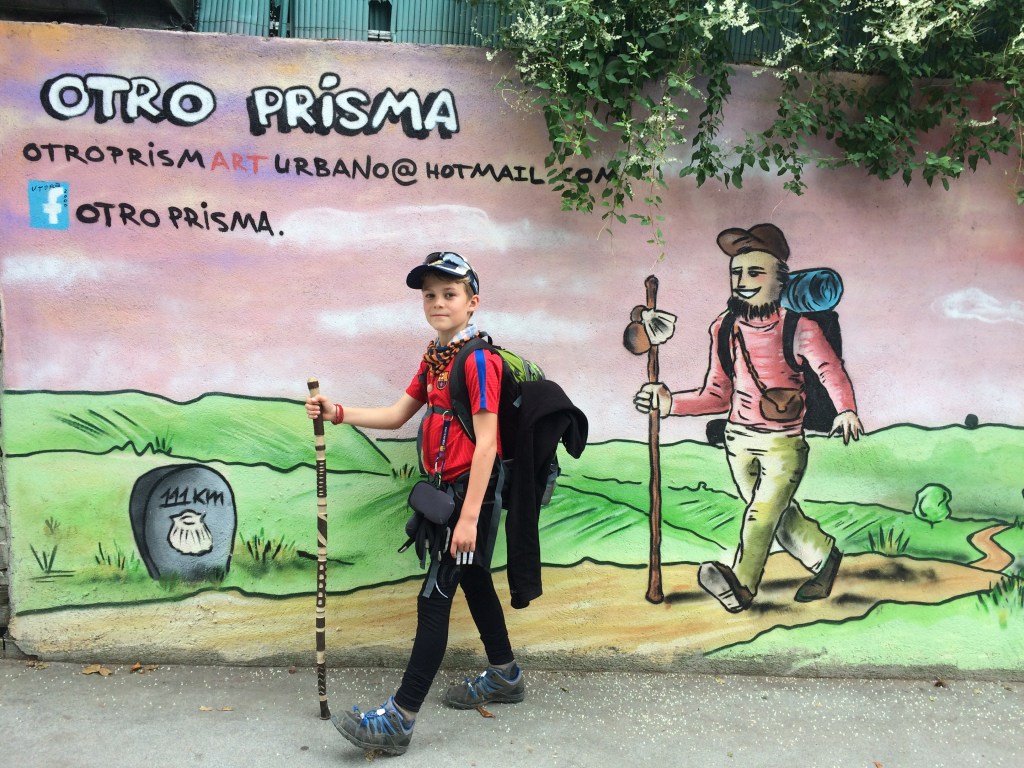
Symbolically, my life in 2001 was plagued with abrasions that caused more pain than pearls and by 2016, my first Camino of 250km with my then 11-year-old son, I had recognised and was acting on my need to nurture my wounds.
Some people diminish their wounds; some deny them; some go into a trauma response and simply obliterate them from memory; some defend their wounds and use their pain as a badge of honour, and some just never quite manage to shine because that would mean giving up on the psychic injuries they have been subjected to.
Adapting to different footwear—I now wear Altra trail running shoes for Camino and will be wearing T-Rockets running sandals on some days too—and conditioning my feet long before the journey, as well as every day before and after walking, is a good analogy for building capability and competency to face challenges … and also to recognise where the stone in my shoe is going to hinder my journey and where the stone in my shoe is the grit that the oyster uses to make the pearl.
It is erroneous to bandage and splint healthy body parts, so there is a call for discernment in how one treats one’s wounds, both from the past and those that present themselves currently. Self-care can reprogram one’s emotional, physical, psychic and mental bodies to engage differently with personal injuries or traumas and shift perspective from being overcome by wounds to using them as a pathway to healing.
As I walk this journey from next week, for Mental Health I will be intentionally working with fellow pilgrims who approach me with specific needs around grief, loss, trauma and dis-ease and I am cognisant of needing to be discerning in how much self nurturing and self supporting I must do in order to be able to support others on their unique walk to wellness.
We are not here to be perfect, we are here to heal. And the first part of any healing process is to recognise the wound as a symbol of healing rather than as an obstacle in its way. It’s important to not get too attached to the strapping and then fail to acknowledge that the wound is no longer there. Struggle can be used as a tool to justify one’s actions or one’s suffering and to eliminate the need to step up and show up. A wound isn’t a life sentence and a bandage isn’t a ticket to victimhood. Letting go of the identity of injury can be empowering and can create the space for taking on the responsibility of stepping fully into one’s essential self.
Take care on the journey by training well in order to diminish the risk of injury and by also preparing well by carrying a first aid kit.
Questions to ask yourself:
How do I grieve whilst supporting others through their struggles without comparison?
How do I create discernment between compassion and a bleeding heart?
How do I bandage the internal wounds that hurt more than anything that bleeds?
How do I relate to past wounds, injuries and traumas on an emotional, physical and mental level?
You can follow, support and share my Walking for Mental Health fundraising campaign on BackaBuddy. All my socials can be found on LinkTree.
It may look like the same route as the hundreds of thousands of pilgrims before you yet it is different for your walking it. A pilgrim’s unique footprints make for a unique pilgrimage.
The Yellow Arrow is a sign of reassurance that one is following one of the routes on the pilgrim’s way and is an iconic symbol of direction in one’s life as well as ancestral direction and rites of passage—pointing out A way which is different to THE way.
When finding and following these markers it’s a reminder to honour those who have come before. There is a ritual to walking a path that many have taken before, honouring them for carving the way and then honouring oneself for creating one’s own journey from the way. There are many paths leading individuals back home to themselves.
A well-trodden path is still the path untaken until one actually takes it … and then one gets to make it one’s own. It is important to get lost in order to find my way and there is a particular practice of non-judgemental observation that comes with the acceptance of this. I feel it’s important to find myself in a place so unfamiliar that I am challenged to work out how to come back to myself or to accept the new place in which I find myself.
Every part of the entire universe is already right here in this one moment … this one step. There is no manifestation magic in life; it’s all about showing up and placing each foot down with attention and intention. In alchemy it is the third stage in the process, Citrinitas, which is the stage of education before Rubedo, the stage of transformation.
The present moment is your refuge, and this is your home … each footfall brings you back to your self and each self that footfall brings you to is changed because of the footfall. Each contour is as unique as the contours on each individual’s thumbprint; each arrow perceived as just a subtly different shade of yellow; each vista viewed with new eyes; each drop of dew a different prism of light.
Stepping into each moment builds awareness of what’s in the way, where the path is leading, how open you are to your intuitive GPS, when to follow outside signs or inner cues, when to change direction etc. Trust in self appears in the showing up without knowing where the path goes but recognising that no matter where it goes it is going somewhere and it’s ok to adapt along the way. It’s impossible to be ready for every eventuality before a journey but it’s possible to be prepared to be resilient enough to figure it out on the way. To be able to flex into the curves and detours of any journey is a skill we can develop through recognising that there are over seven billion unique humans and, therefore, over seven billion unique paths.
Questions to ask yourself:
Where did I lose my way?
How was I able to find my way again, find a new way, or ask someone to guide me?
In the moments of getting lost how did you recalibrate to a new way by asking for guidance?
You can follow, support and share my Walking for Mental Health fundraising campaign on BackaBuddy. All my socials can be found on LinkTree.
The Walking Stick is a symbol of those people in one’s life who assist in upliftment, encouragement and forward momentum. Having an emotional, physical and spiritual staff to lean on can help traverse tricky terrain.
I don’t walk with poles or a walking stick—in fact the few times I have used someone’s for a difficult crossing or steep downhill, I have fallen. This indicates to me that I need to become more familiar with asking for support. My innate tendency is to always be self supporting and to hold others up. This can be to my detriment if I can’t equally find the people and resources to support me in supporting others.
A Walking Stick can be seen in the negative light of a crutch and using one can be seen to highlight one’s disabilities. It is, therefore, imperative to give this an archetypal symbology that encourages its use. The sense of outreach in difficult times is so key to reducing suffering and restoring well-being.
This current campaign to walk 1,000km to raise awareness for mental health and suicide prevention made me extremely vulnerable in the asking for support and extremely disappointed. My lessons around support are to lean in only when the support is actually there and being mindful of expectations of it, without using the lack of people believing in me to snap back into being 100% self supporting again.
When you carve a walking stick that ultimately provides support for your pilgrimage, it is like an analogy that can translate into the care and love offered to and infused into another human being that ultimately become the food that fuels that individual to be the support you one day may reach out for.
The pilgrim’s Walking Stick is a symbol that young, able-bodied people also make use of this often necessary tool for of support and that there is no stigma attached to utilising it, whether walking 5 or 45 legs of the Pilgrim’s Way. Using a Walking Stick can be a practice of mindfulness and gratitude—a way to honour the self and the body in recognition of its strength and also acceptance of its fallibility.
It holds the intention and reminder that there is always support at hand and it will challenge a different response when either needing to ask for or accept the offer of help from others. I can lean on something/someone temporarily and it’s ok to then lay it down, until needed again, without a) feeling obligated to be enslaved, and b) depending on it always being there.
Questions to ask yourself:
What held me back—cognitively, emotionally, somatically—in asking and/or receiving a hand of support today?
Who are the people in my community, tribe who are my walking sticks in life and how do I honour these people more by being receptive to their care?
You can follow, support and share my Walking for Mental Health fundraising campaign on BackaBuddy. All my socials can be found on LinkTree.
As I embark on my most challenging pilgrimage, 1,000km on the Camino de Santiago in Spain, Walking for Mental Health, I am drawn back to reflect once more on the symbols of The Way that I have previously walked with.
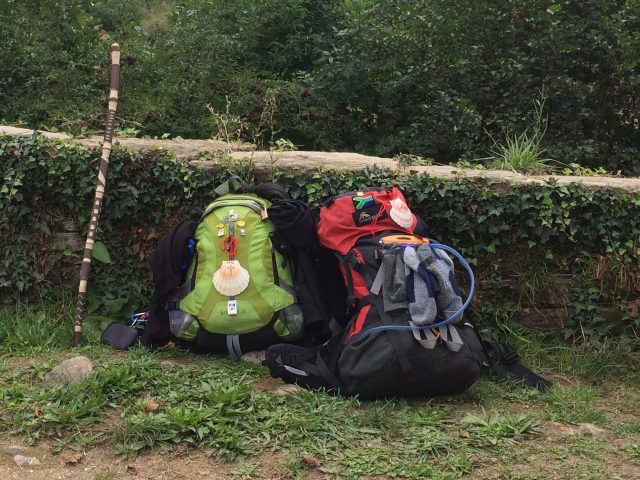
The first symbol is the most important for me as it indicates the strategic part of the planning phase as I consider what to pack … adding and then eliminating … ruminating and deliberating … trying to envisage the climate, the landscape, the skin feel and mostly—perhaps obviously—the weight vs the comfort of choice.
If a backpack is too full, the physical body will be strained over capacity and the mind will be less focused on the path ahead as a consequence of the pain. Carrying an extra weight on one’s shoulders has become normalised and it’s common for people—adults, children, corporates, healers—to be brought to their knees by this weight before asking for support. Equally, the journey can be hindered by too light a pack as a result of not paying enough attention to the necessary items one needs to carry on a journey; this could also indicate a—conscious or unconscious—negation of certain personal needs and basic requirements for comfort and health.
We all tend to accumulate too much, often out of fear and death denial; a habit that is hard to break and one that ultimately results in being unwittingly burdened with more than we can carry. It’s important to see what and who lies beneath the layers we have built around ourselves and the burdens we have chosen to carry, and then to create new habits to do with shedding rather than accumulating.
To strip down on an emotional, physical and mental level takes courage because it shows us our authenticity and the corresponding vulnerabilities. By stripping down I don’t mean full renunciation; I refer to discernment around needs according to values and a slow un-layering in line with each person’s capacity and desire for transformation.
Questions to ask yourself:
What am I carrying today that may not be mine and/or what is the impact for me?
What can I remove from my backpack, and who, if relevant, can I give it to?
What’s essential that I might add or that would be worthwhile adding to my backpack for now?
Observations:
Awaken your ability to recognise when, how, where and for whom you may be over-burdening yourself.
Build your capacity to feel into how your whole system is responding to the weight you are—intentionally or unintentionally—carrying on a physical, mental and/or emotional level.
Look at what doesn’t need to be there as well as what is potentially missing that will benefit the pilgrimage and ease the long walk.
You can follow, support and share my Walking for Mental Health fundraising campaign on BackaBuddy. All my socials can be found on LinkTree.
As I plan the next Pilgrimage, I reflect on how I got to this point and how my embarking on this journey to raise awareness for Mental Health has both negatively and positively impacted those in my circle, my community and my life in general … and the corresponding impact others’ attitudes, words and actions have had on me.
Depression has become that kind of familiar place that I am now able to visit—albeit unintentionally—and, despite the mostly unbearable discomfort and burning desperation to either just die or get out, I can sit in the stench of it and allow it to show me the neon signs of my next destination.
Sometimes I simply want the signs to say, JUMP! or TAKE A VERY LONG WALK INTO THE OCEAN! Sometimes I don’t want to notice the EXIT sign because life outside of this black hole can seem too scary compared to this familiar discomfort. Most times, as in this current case, the signs are so glaringly powerful that they kick my ass out of there with no choice but to follow the trajectory they are pointing me to.
When I stopped anaesthetising the discomfort of my dysfunctional marriage with alcohol and sugar 15 years ago, I took to running … and running … and running some more. And when I again chose an abusive relationship that ended in verbal and sexual violation, I walked 450km in Portugal on two separate and consecutive Camino de Santiago routes.
Sitting in the trenches of this most recent depression, I was booted out only on reaching the point of knowing the only thing that could literally save me was to walk … far … long … intensely and intentionally … and in collaboration with my most pronounced character trait and, consequent greatest value: showing up in service to individuals, communities and to the environment in a manner that allows whatever it is that life is wanting to live through me.
I can inordinately deliberate over choices. Reaching the decision to walk 1,000km across Spain, and subsequently coming to the realisation that I wanted to do it in an altruistic manner, however, happened in less than 24 hours. It took another 24 hours to reach the decision to turn it into a community collaboration by launching a BackaBuddy fundraising campaign to ask for support in order to support. https://backabuddy.co.za/campaign/walking-for-mental-health
With full transparency and gut-wrenching vulnerability, I have revealed truths about the foundations of my innate need to walk and my motivation around raising awareness for Mental Health whilst guiding others on their own unique walks to wellness. And I have revealed my desire to do this through my existing social media channels, a new YouTube channel and on a crowdfunding platform so that others can ride the karmic wave of altruism and awareness. https://linktr.ee/Walking_for_Mental_Health
Asking for help is the most difficult thing for me—it exposes me to the vulnerability of growing up with no support. I may as well be standing stark naked in front of the cathedral for how open my heart is in the asking. This led me to writing about the Symbols of the Camino de Santiago and back to the beginning paragraph which I will elaborate on in another post that will detail each of the most significant (to me) of the symbols and how they have highlighted so rapidly the support, direction and purpose that have come from somewhat unexpected places.
These astounding growth moments in life shake up my prior beliefs, hopes and accidental expectations and fully recalibrate my mind, my heart, my soul and the entirety of my very being into a new stronger holding pattern that weaves a new narrative around the thread … that single piece of fibre … I am left holding, when all else has unravelled.
This is the end. And what I choose to weave—and with whom—is where I begin.
‘When we try to pick out anything by itself’, says John Muir, ‘we find it hitched to everything else in the universe.’ Water is like this. It holds and connects the memories, dreams, illusions and delusions of everything and everyone on the entire planet.
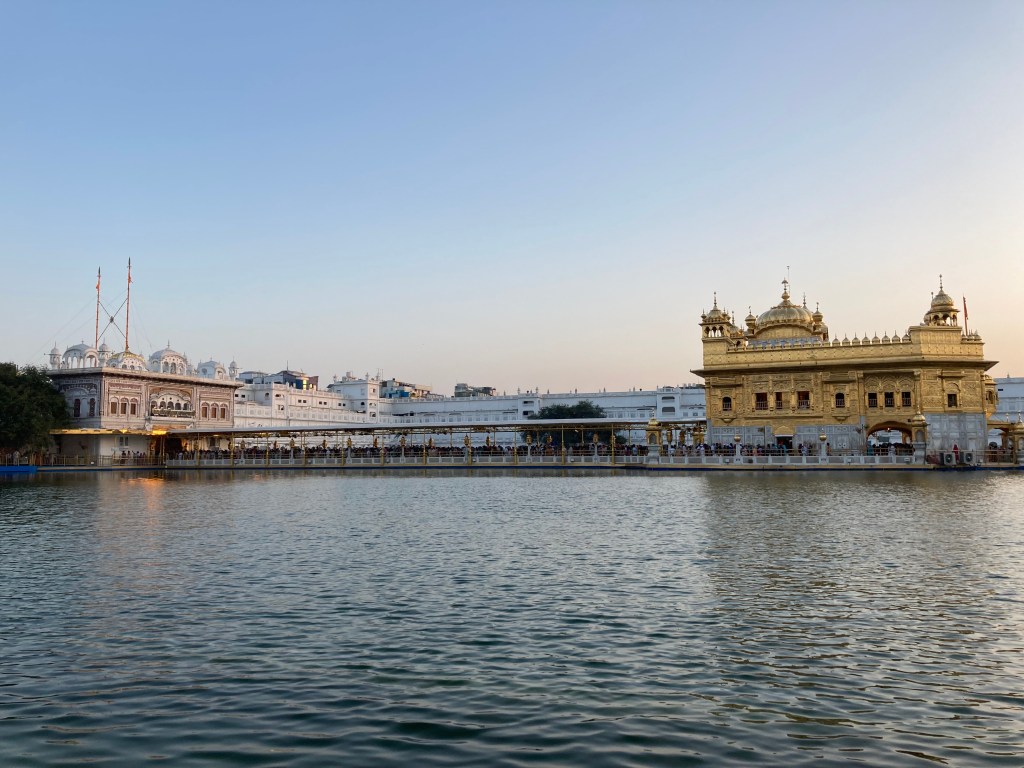
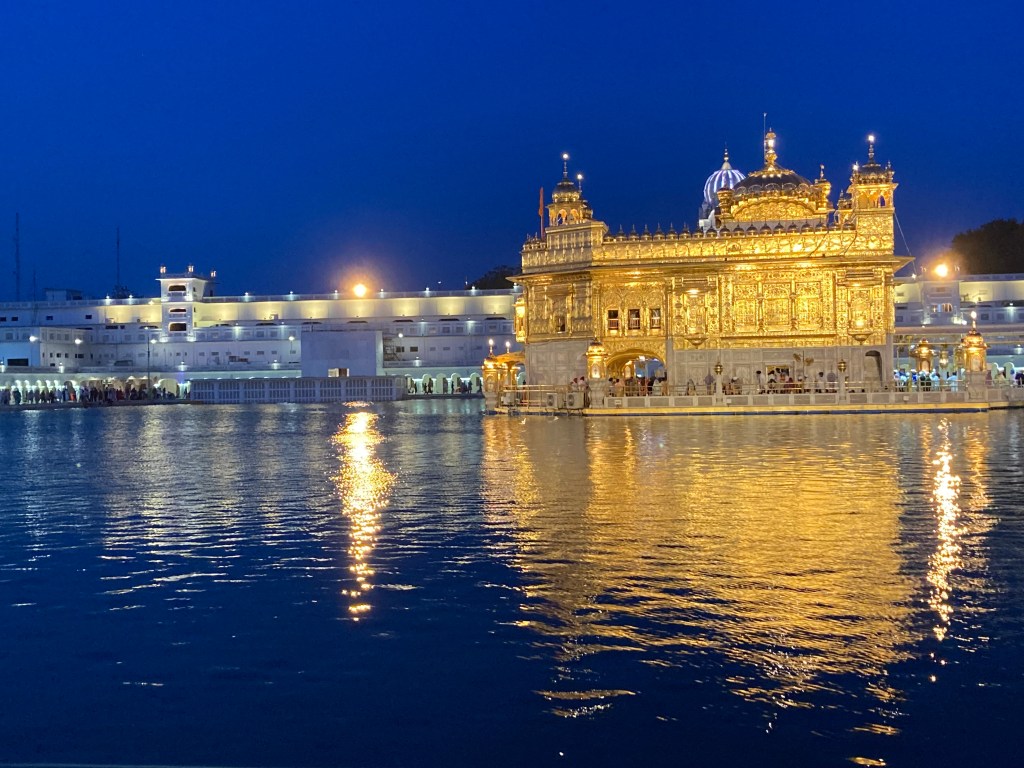
With the chaotic India I know and love loitering just meters beyond this walled compound, I stand with feet braced on marble slabs radiant with the morning sun. Undulating water captures the reflection of Amritsar’s Golden Temple, bewitching its leaking image to manifest magnificence greater than the structure itself. Mesmorised, I weep … viscous tears that stick to my eyelashes and blur my vision before, ever so gradually, building momentum to slide down my cheeks and settle at the corners of my mouth.
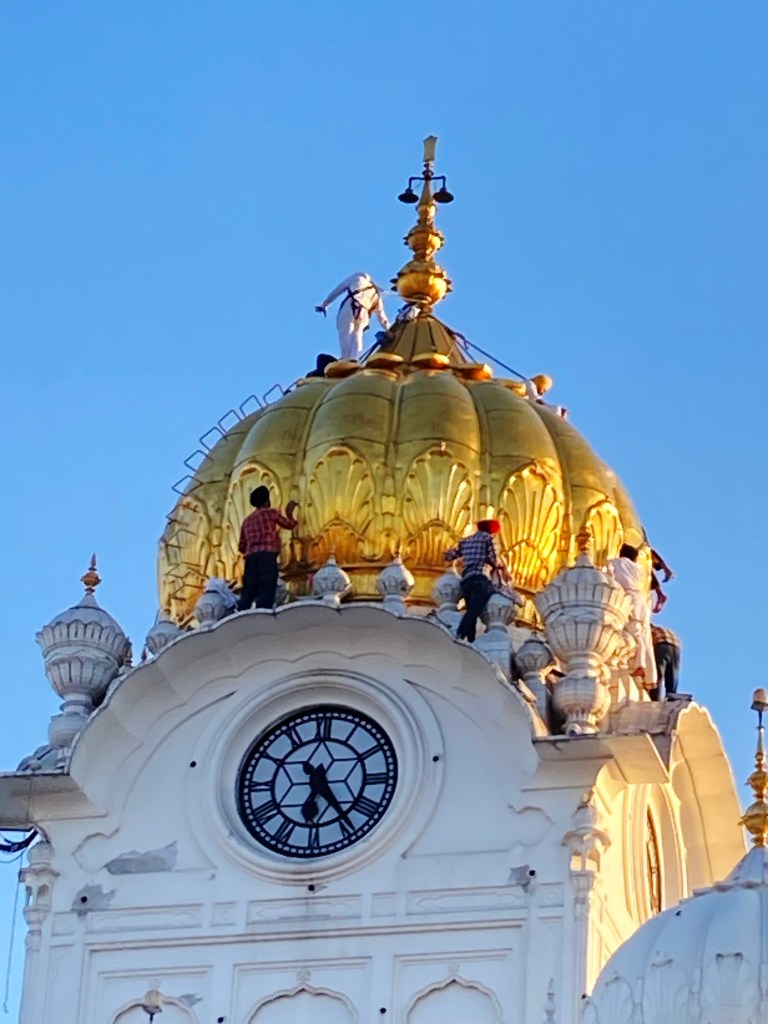
Gu means darkness or ignorance; Ru means elimination of that darkness; Guru means light coming from darkness, and Gurudwara is the doorstep of the Guru. Amrit means ambrosia, a substance so aptly reflected in the name given to the body of water that, bar a 65m causeway, maroons the Seikh shrine crowned with a 500kg gold-coated dome: Amrit Sarovar. Simply looking at it floods me with a somatic response that hitches me to everything beyond the soma.
If water holds consciousness—or, in fact, is consciousness itself—then this temple amrit, where literal millions of people have come to bless and be blessed, is so much more than the sum of its parts; more than the sum of the pilgrims, devotees, travellers and nomads who plunge themselves beneath the surface of this sweet nectar to emerge, reborn.
Travel, for me, is like pulling a treasure chest out of the depths of the ocean. It is my rebirthing. All things both delightful and frightful; shiny and shocking. Covered with barnacles, seaweed, and throttled by umbilical rope, the treasure is locked away with rusted chains, seemingly impossible to access. Yet there it is, and the only obstacle to gold and jewels is reluctance, resistance, fear and ignorance. This is the growth point—the crowning—adapting through a myriad complex situations to bring new clarity.
I stand at the door—on the limen—to my inner guru, seeking the gold that only I have the capacity to alchemise. The treasure is the deep inner landscape of putrefaction; the transmutation of lead to gold with each step, thought, emotion and prayer. Yet, like my tears, water has the capacity to both obstruct and clear one’s vision. And so I too must annoint myself with this ambrosial amniotic fluid so I can bust open the rusted lock and emerge from the treasured womb of my dreams.
Like the four or five hours’ long queuing that devotees must do in order to glimpse the holy book in the inner sanctum, there are no shortcuts to the treasure when a decision is taken to navigate the deep work of psychic dredging. If you want to get to the Inner Sanctum, you must be prepared for drudgery, claustrophobia, patience … gallons of it.
Where vision is blurred, alchemy brings insight. The tears that ebb and flow—the nectar-like medicine for my soul—this ancient wisdom claims, are the crystallised thoughts that life and love can trap. A holy dip strips me naked, to the bone, layer by karmic layer. Never gentle … always strong … water can cut grooves in stone; can rupture mountains; can ratchet open the mind and return its forgotten essence to the curl of the upper lip, where the tongue can catch a glimmer of it’s wisdom … a cyclical flow of watery tears to saturated consciousness awakening my psyche. A re-cycling; a re-viewing; a re-membering. In unbecoming, I become it all.
If the SriNagar lakes are for me the primordial fluid, and the tunnels through the mountains back into India, the birth canal, then Amritsar’s Golden Temple is the ritual purgation that prepares my new soul for incarnation. I use the experience of my body to access the inner dimensions of my being—my ultimate and quintessential source—to perpetually step up to meet my dreams … because it is only the wise who recognise that their dreams are always on their side.
The heart doesn’t wrinkle. Emotions grow only more fine with age. The mind surrenders. And the soul wisens and expands beyond it all.
As I step into life, I get lived. As I live, I become life itself.
Mercurial Gemini with a strong intellect and speed, I get myself so tied up in knots over labels and judgements; flummoxed by the dangerous new age bullshit of either being in my head OR in my body. My pilgrimage this past year has almost broken me; taken jackhammers to my psyche trying to understand where the unique intersection is between the paper doll, the shadow and the self; made me sick wasting energy justifying who and how I am … on blending two parts of myself that were never separate.
“Now, about that word authentic. It is related to the word author—and you can think of it as being the author of your own self.” — Marion Woodman
Being authentic and spiritual makes me the more real, not the less. It guides me on those internal spiralling pilgrimages down passages of grief and awakening. I touch into every part of me that is also a part of you and therefore a part of everyone and everything in the universe. I can’t hide or deny any aspect of myself. And so I write and I walk and I journey to the places most are afraid to go; places I am mostly also afraid to go.
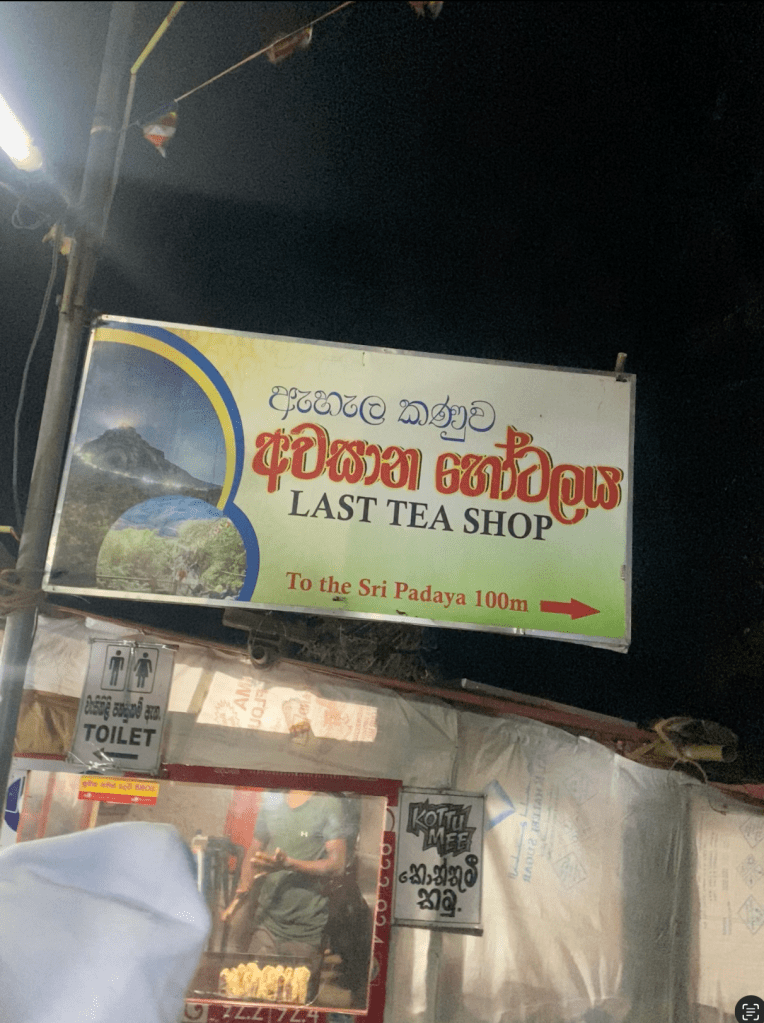
Slightly Chilled. The name of a guest house I pass on my walk to find real coffee. Nescafe signs send me away. Coconut time. I walk to the river and put my feet in the coolness. Vegetable Garden House is Super Chilled—the family, the garden setting, the beautiful young travellers I meet over delectable Sri Lankan breakfast dishes and weird Sri Lanka coffee.
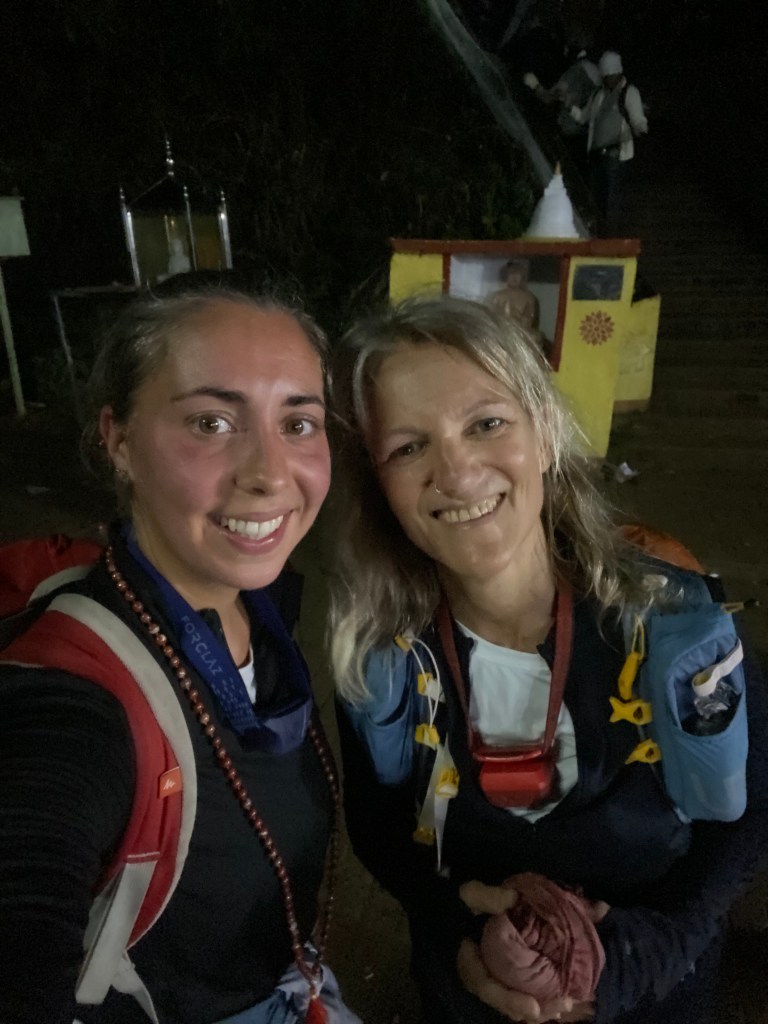
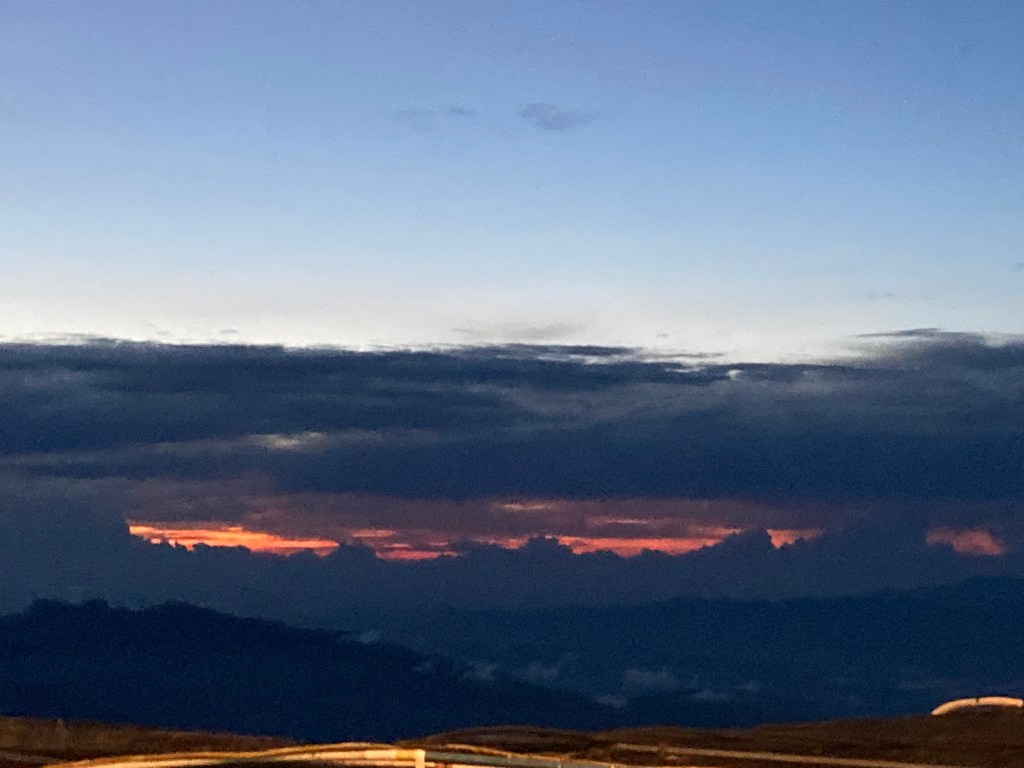
I wake before the three alarms I have set. It’s 1h40. I am dressed in full hiking gear when I climb into bed at 8pm. My fast-pack is loaded with every warm item of clothing I brought with me, including the pink shawl (the Diana I take on every pilgrimage), a kikoi, extra socks, an entire change of clothing and merino wool gloves. Geared up with head torch and rain jacket, I emerge from my room to the sight of a woman also kitted out for the climb. Her name is Cami, she’s from Paris and it’s her 32nd birthday. It’s hard to imagine I’m twenty years her senior. I feel 35 again, meeting young travellers on their first round of adventure. I get the sense I am being appraised with a measure of curiosity; they are not sure which bracket to place me in as I am the age of the mothers who are in the process of making home and being normal.
Walking this path often means walking alone. And alone isn’t about being without people but without the capacity to articulate my sense of self. Relationships fail for me because I attach to an ideal based on what the world wants from me rather than what I myself want for me; I attach to the illusion of what it promises despite knowing that intentions are generally to ‘fix’ my rabid self reliance in order to make others feel less conflicted and more comfortable with their own erroneous attachments.
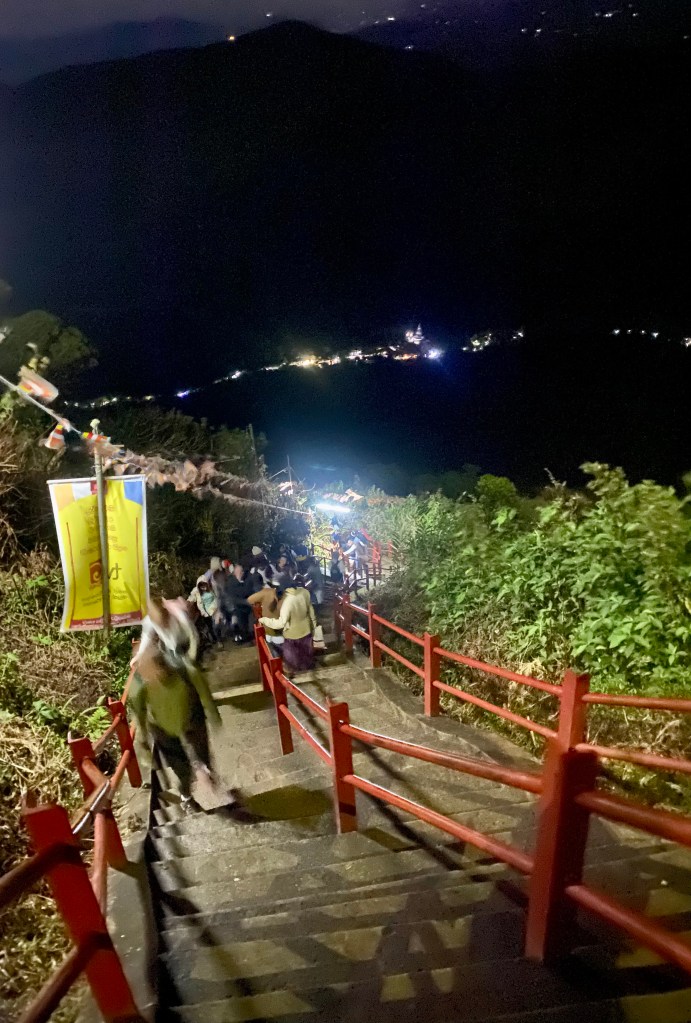
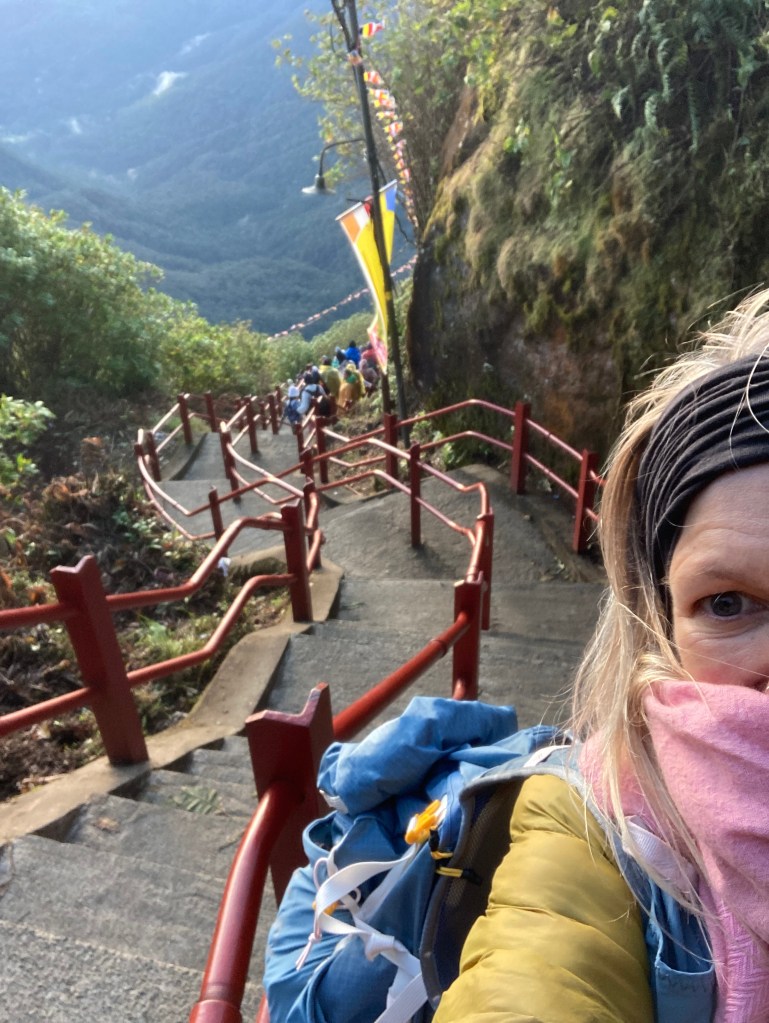
Most hikers in Cape Town know the Newlands Forest 400 steps. Add another 5,100, throw in a gazillion tons of concrete, hundreds of neon lights, tea stalls, sweet stalls, Buddha statues, snack bars and innumerable walkers from as old as ancient and as young as infant. It’s a lot to take in. I have the intention to do two nights in a row up SriPada. I am delusional.
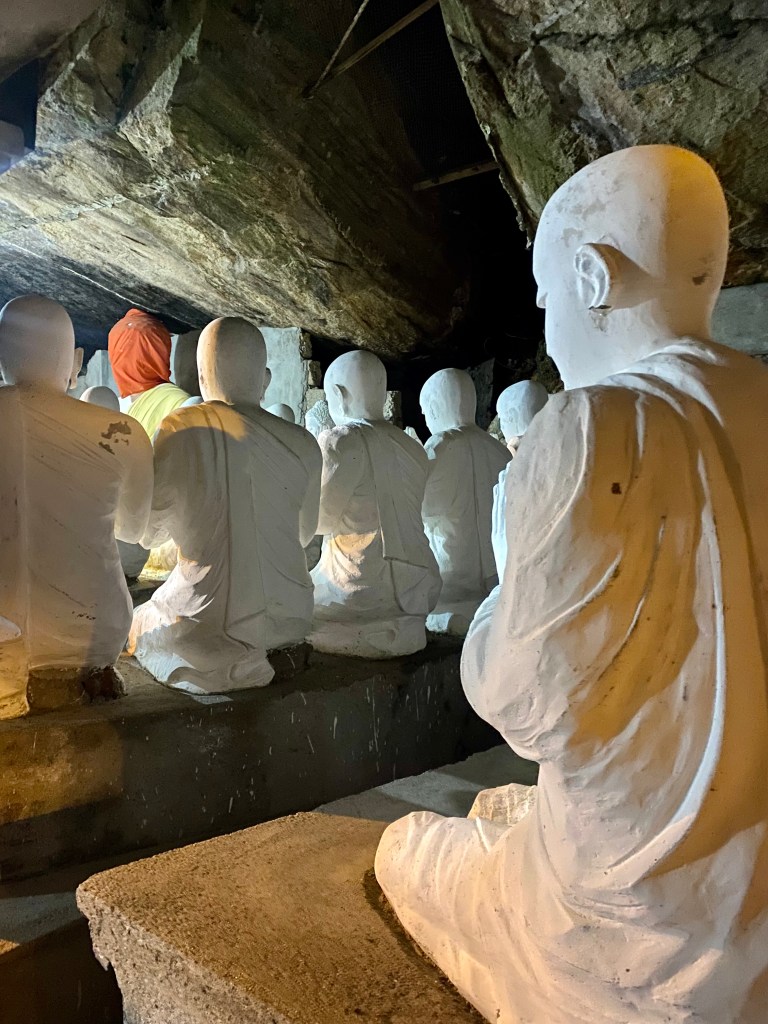
Like the star at the top of the Christmas tree, the cluster of neon lights marks the end point of the climb, where the foot of Buddha is believed to have dented the top of the hill. I am initially captivated by the continuous row of lumens lighting up the path until I recognise the reality and the altogether fabulous absurdity of it all. A monk ties a white string around my wrist with blessings for the journey and, similarly to the Camino de Santiago scallop shell, I am branded a pilgrim and given kudos for my commitment.
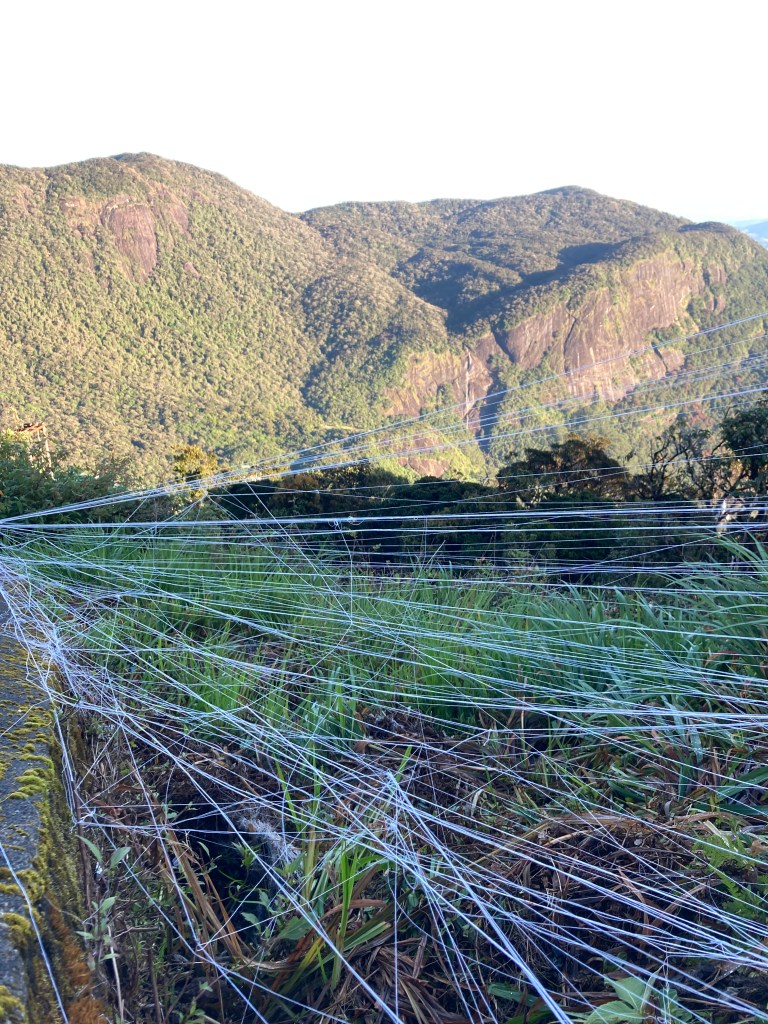
I navigate new pathways and pave new neurological networks. Like the silk of the spider’s web or moth’s cocoon, the white pilgrims threads create initiation networks, a semi-permanent anchor on the railings. I lay paths that others may follow, not because I know my way but so others may know it’s okay to not know. There are no solid lines on this map. Only hyphenated. A dot-to-dot puzzle. This is my Sadhana.
People sleep where they sit. A young girl walks holding her mother’s hand; sleepwalking. A man walks barefoot; it’s his 15th time to the Peak. “Is that a spiritual thing?” asks my walking companion. “No, my boots got too heavy”, he replies, focused fully as he places each footfall tentatively on the gnarled concrete. But I feel differently. That kind of pain can only be a spiritual experience. People carry babies and toddlers, people sing to encourage each other, and the elderly use the railings to replace worn out knees. Babies cry; some adults too. It’s an endless river in flow, night after night after night. The same yet always different.
Everything in life is pilgrimage. Nothing we do or say or love is unique. Yet, in pursuit of being individual … special … we try to carve our own way and, in doing so, fail to recognise the struggle, the value, the pull, of all the millions that came before. And without proper ritual to honour the trajectory of sameness, we ultimately get lost.
I lie awake on the second night in the shadow of SriPada imagining the thousands more trudging to the peak, and I know that as weird and whacky a pilgrimage it is, I am bound to do it again … many times. People who judge me for my atypical free-spirited escapades also follow me vicariously; afraid to step into the groundlessness of the abyss … smothering themselves instead in the illusion of hoarding for something that never comes. A guru tells me that I’m on the right path when fewer and fewer people understand me.
I travel solo so I can disappear into a framework of existence that doesn’t require justification or proof of my being. I travel solo to untether myself from these insidious and relentless chains curtailing my capacity to simply be. I travel solo so I can re-understand myself.
I don’t call myself a healer because that would allude to an end point. There is no end point, there are always only varying states of health and vitality and a continuous and persistent path to harmony and wellbeing.
I help you optimise your resources on this journey: 🗝 on a physical level with Craniosacral Therapy; 🗝 on an emotional and mental level with coaching, 🗝 and on a spiritual level with guided nature activities and visualisations.
The goal is not to eradicate all dis-ease, discomfort or dysfunction but to find and develop those inherent resources that you can use to cue your sense of ease, comfort and function.
Let me take you on a pilgrimage and map a new territory.











 WELL WORTH BEING