Evacuation take2

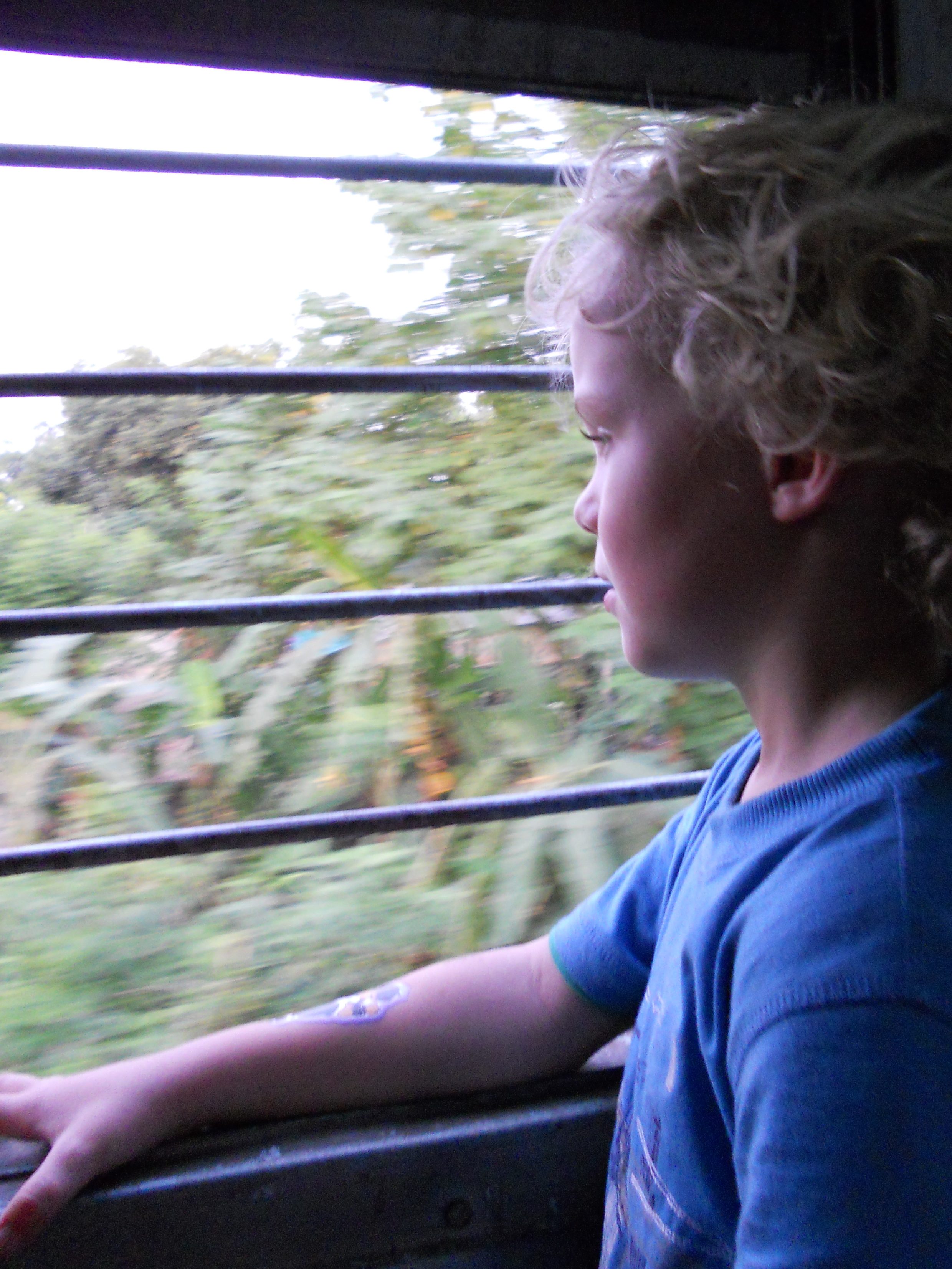
“What the hell is going on out there?” I asked a fellow passenger in the quickening darkness of a train carriage at our first stop en route to the north east of the Indian sub-continent. We had arrived in Siliguri from Kalimpong to an energy of agitation and fast-spreading rumours of an imminent strike. Advised to get to a safer place, I had picked the tiny remote village of Madahirat where I hoped to take Nic on an elephant safari through their local national park, Jaldaphara Wildlife Sanctuary.
The subject of my demand stared back at me as he sliced his finger across his throat.
Before I could take it personally he explained in Hinglish, “One woman dead. Head off.
The cause of passengers leaping and running from their carriages, cameras and camcorders at the ready, was the macabre fate of a woman who had slipped getting onto the train at our very first stop. Decapitated.

As the lights went on in the carriage, the crowd outside, filled with gore from their amateur filming, became a mob as they turned their attention on something to release their restless horror. That something was me.
And as more people gathered, the shouting began. Banging on the side of the carriage. Shrieking for me to get off the train.
A riot had begun.

I kept my eyes averted, trying to ignore the attention, fixing my gaze on my lap where I was holding Nic’s head, stroking his hair, keeping him out of sight while keeping him emotionally safe.
As I began to gather my belongings, someone bolted the doors.

There was just enough English on my side of fate to be told not to comply; not to move; not to respond … no glass in the carriage windows meant nothing to break and solid steel bars meant the barrier would hold.
The police did eventually arrive with their sticks and moustaches to clear the mob, the dismembered body and get the train running again.
Hours had passed.

By the time we arrived in Madahirat it was around midnight. I was still wide-eyed and shaky carrying a sleeping child under one arm, my backpack on my back, his backpack on my front and various other provisions under my other arm. A worried Mithan Das, proprietor of Hotel Relax, a hole-in-the-wall style hotel with roll-up garage door frontage was waiting to take the load off; I had kept him on the phone for an hour during the riot so at least someone knew where we were if we were ripped from our seats, each other, and even ourselves.

A day later the entire area erupted into a situation of strikes, riots, mob violence and general unrest as we were forced to immediately go into lockdown in this grungy homestay in a no-horse town.
The year was 2010.

Fast forward to fifteen years later, I found myself as a solo passenger in a getaway taxi from 4.30am gunning it for eleven hours from Bir Billing to Delhi. Airport closures and missile strikes in the north west of India and a flight out the following week meant I had to move fast or risk being stranded in the mountains. On previous trips I have longed for fate to play the hand of keeping me in India indefinitely but, seven months away (eighteen in total) and already mentally and emotionally prepared to be departing two weeks later, the threats and speculations of war fuelled a mama bear motivation to see my son. I became fixated on getting the fuck out as soon as possible.

An astrologer told me after the incident fifteen years ago that India would always throw up monumental issues for me and—hoo-boy!—does she always deliver … be that on Indian soil, in the form of geopolitics, or back home, in the form of home and relational dynamics, as a consequence of my being in India. 

A friend in Bir Billing in the foothills at the Himalaya told me that India is cuffed on one side by Bangladesh and on the other by Pakistan.

Fifteen years ago Nic and I unwittingly crossed into an area of conflict that included the derailment of trains and the fatal stabbings of foreigners as riots tore through the north east cuff in a fight for sovereignty in the area known as Ghorkaland to those seeking independence from India. This time I was also in a small northern mountain village on the opposite side of the continent where the other cuff was fighting again in their decades-long grab for Kashmir and a crack down on terrorism. In 2010 the conflict was very localised and we were right in it. The police commissioner, acting on behalf of the British Embassy in service to our protection, arrived at our door to instruct us to not even think of getting on a train or, for that matter, to go more than a few hundred meters from the homestay. “You will be at the mercy of brutal mob murder if you venture out”, he added. There was no malice, just a need to convey the severity of the situation and ensure I understood this was not a matter to overcome.

In this current situation I was not in immediate danger, bar the possibility of a misguided missile going off course en route to one of the many military bases in the area. 
Both times transport was an issue. Last time train stations were being shut down, this time all the airports in the north and west were closed—the terrorists were using civilian aircraft as a shield to shoot missiles that India couldn’t bring down without the risk of hitting said planes.
Most significantly though is that both times my location was geographically on the wrong side of the conflict putting the zone of danger between where I was and where my flight was.
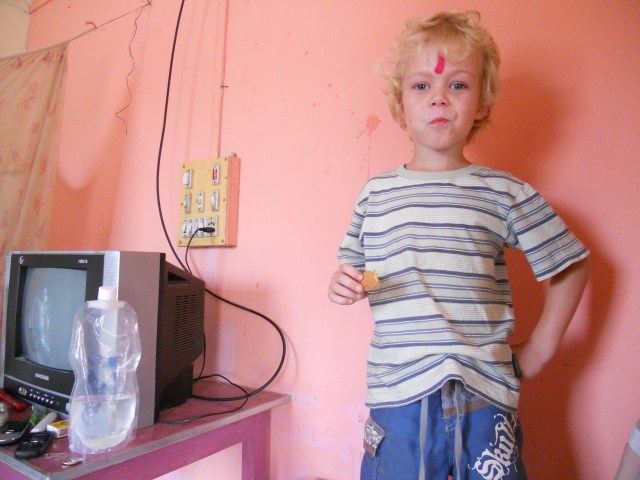
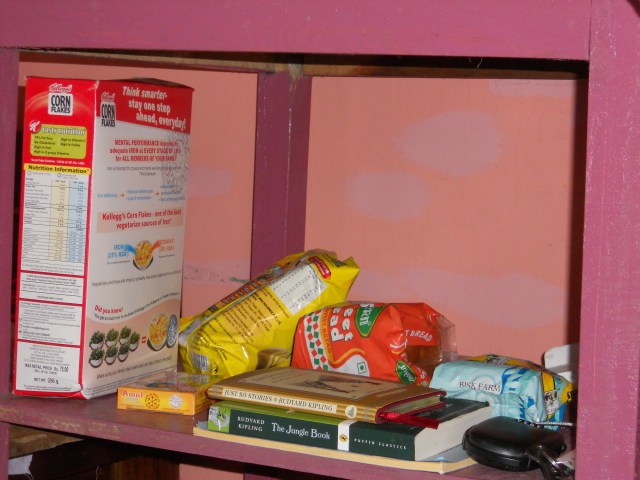
In 2010, several days after we went into lockdown, our host rushed in saying we had 20 minutes to pack; a jeep was coming to smuggle us out. The rebels had declared a 3-hour moratorium for people to go out for provisions. It would take approximately three hours to get over the bridge that marked the boundary and if there were any glitches along the way, we would be in severe danger and in violation of the curfew.  If anyone stopped us, he added, we would have to pretend I had a medical emergency. I doubled over and cried … briefly … stood up, flexed, wiped my eyes … pulled out my geranium moisturiser for these emotional crises … and then packed at breakneck speed while Nic listened and sang along to songs on his iPod, munching on the remains of the dry cornflakes, crackers and processed cheese we had subsisted on for days, the remains of the red dot on his forehead from the morning’s pooja, smudged across his eyebrows.

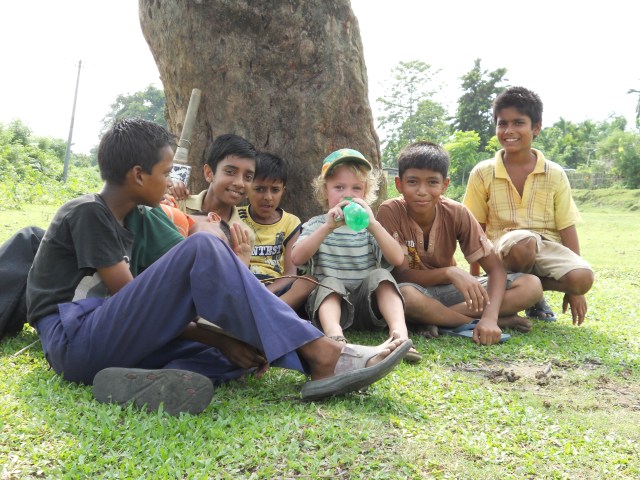
The delight of travelling with a 4-year-old is that I had to get creative. With a child it’s important to keep them informed whilst keeping them safe—physically as well as emotionally. And I got to perceive the reality of each moment through his eyes whilst managing my anxiety as a separate monster that in each moment was only a reality of potential threat rather than an actual threat. The reality was that we were stuck; the reality was that there was violence and murder close to but not in our tiny village; the reality was that we could play in the park and Nic could play cricket with the village boys; the reality was that we had an ancient TV that played Tom & Jerry and Nic had an iPod with hours of stories; the reality was that we were still mostly on a superb adventure isolated from the rest of the world.

This experience fifteen years ago shed a different light on my recent evacuation drama from missile strikes and the threat of war between Pakistan and India. It helped me keep perspective. It gave containment in a situation with zero support.
But I was still afraid.

In a world where emotions get labelled negative and positive, and false positivity seems to be lauded over pragmatic and oftentimes necessary negativity, I get exhausted by people accusing others of choosing to live in fear … when fear is the exact emotion one has to live in when needing to react to a terrifying situation.
Fear has been my friend.
Without fear I would have remained in my marriage; without fear I would have been too trusting in too many situations; without fear I would have boarded a train to imminent death; without fear I would never be motivated to take action out of harm’s way for myself or my child; without fear I would not be guided to make decisions based on gut rather than brain. 
Every emotion is a tool in our toolbox and the key is not to throw tools out when they’re not working for something but instead learn their purpose and function within their range of benefit to the task at hand. 

India stimulates every emotion in my being and shakes them all loose. I am in Cape Town now to calm my sensory overload and prepare for another departure later this year … somewhere other than India this time. India is always and forever my growth point, but I just feel I have had enough growing for now.
Diana and the Horses

My grandmother, Diana Mellor, was born in Mussoorie, India. Activist, artist, storyteller, writer and something of an enigma and inspiration, I felt the way she was also an outlier like I was meant that perhaps we both came from another world. My father—her son—slipped between convention and this other dimension. Our curiosity, humour and mischievous nature run like a thread from her down the paternal line and continue through my own son. In my memory, she was one of those beings who always glowed with radiant light and I often consider her to be my real mother in terms of character traits and looks. Her silky slightly-strawberry blonde hair remained that way almost until her death in her 80s and, although I can’t claim to have kept my own grey at bay, I have her and my father’s big blue eyes that she would declare came around corners before I did.

It was once I had discarded the parts of my life and my Self that needed shedding and began to build (literally) from scratch, a new life and home that I began to fully comprehend how much of an influence her eclectic house, filled with treasures from her travels, motivated my own treasure-filled sanctuary.

In Colonial India, expats would go to the hill stations in the heat of summer and to give birth. Her Irish mother fit this demographic, hence the geography of her becoming in the world. As a judge in India in the early 1900s, her father was likely not one of the good guys and yet I do often wonder if Diana’s compassionate heart, deep wisdom and stoic acts of courage were a result of good modelling or bad; whether she became who she was because her father too was against the system of oppression or if who she became was in fact an act of rebellion. My father too was something of an outlier, acting perhaps unwitting in alignment with his mother’s core values despite them being somewhat unusual in the political climate of South Africa in the 70s and 80s. This is the genetic line I follow and one that has created a chasm between myself and a family that cast me out for my perspectives, my diversity and my differences.

How this relates to where I am right now and the way I choose to live my life—now that I have unshackled myself from the structures that kept me bound for most of my life—is the polyamory I am currently engaged in. It’s not what you think … let me explain.

Diana would dress up as a gypsy at our birthday parties and tell our fortunes, something quite intriguing in the societal construct of the 70s. In my memory this was a regular occurrence but I can’t actually remember if she told my fortune just the once or if it was my neurodivergent brain that held onto it for its mystery and, to a degree, a truth I would only fully unravel decades later.

When she told my fortune, she would tell me I would marry a man who rides two horses at once and I would spend my marriage stitching up his trousers. Although I am not sure I ever stitched up any trousers, both my husband and the lover I took after leaving him (ok, maybe a few more too) always had a couple of fillies to ride.

Despite this duplicitous behaviour by my then husband, I can’t help but wonder if the real cause for my divorce was in fact my own affair … with India.

Diana had, in her final years with Parkinson’s Disease, begun living in parts of her brain that transported her to the bygone era of riding on elephants through the jungles and seeing tigers. Ironically, this was when I got to know and understand her deeper and this is when the seed that would take another decade to germinate was planted in my psyche. 

I hadn’t intended to travel to India—the end of the 20th century saw me in London, working in Investment Banking and way too invested in a pseudo lifestyle to follow any gurus or hippies to a land I didn’t trust for its cleanliness or safety. But the airlines had other plans. Not being able to get from Nepal to our next destination, China, from any airport other than Mumbai, I plotted a route overland from Kathmandu to Varanasi, through Bodhgaya and Agra and touching into Rajasthan before an overnight bus ride down the west of the sub continent to the airport.

I didn’t intend to stray. I unwittingly fell in love. Returning to South Africa in 2004 was preceded by a two-month pilgrimage, beginning in Mussoorie and weaving around an extraordinary number of towns, villages and cities throughout India. I didn’t find Diana’s birth record, which was the deeper intention, but I forged a deeper bond with this lover.  It felt like I was cheating; the marriage couldn’t include such an intense lover. I fell deeper still in 2010—once separated from my husband—when I took my then 4-year-old backpacking for 5 weeks across the country.

After that, I sold my diamonds and my shoes and anything of value that I no longer needed, to fund tickets and travels back to arms so much more loyal than what my marriage and my subsequent lover gave me.

And I was faithful to her for over a decade. Until my gap year.

I fall in love with cities and towns and villages now like I once fell in love with men. From SriLanka in December 2023, I returned to India with resistance as though I was being forced back into a relationship with something I might have outgrown. She took me again, reluctantly at first and then I was hooked again … until I went to Nepal for a few months and decided this was definitely my greatest love.

So, no, I am not married or tethered to a man straddling horses any longer and the only stitching I am doing is the weaving of a new heart … straddling countries like lovers between whom I cannot choose.

Can I choose polyamory?

Eighteen: Alchemy and Ambrosia

‘When we try to pick out anything by itself’, says John Muir, ‘we find it hitched to everything else in the universe.’ Water is like this. It holds and connects the memories, dreams, illusions and delusions of everything and everyone on the entire planet.

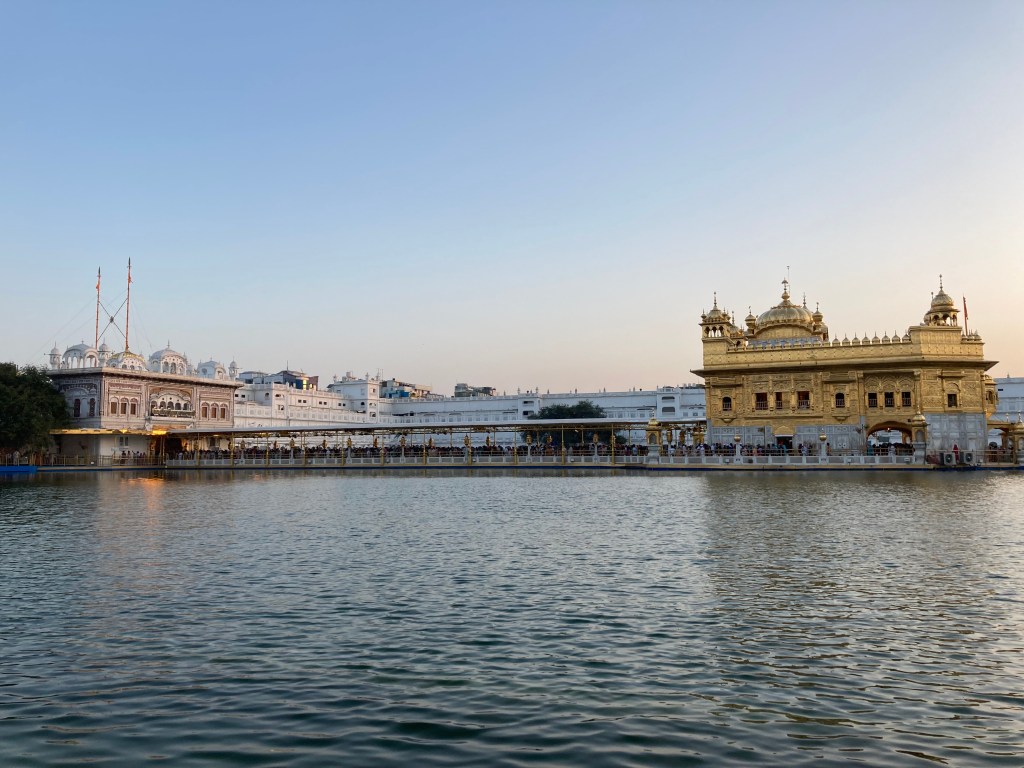
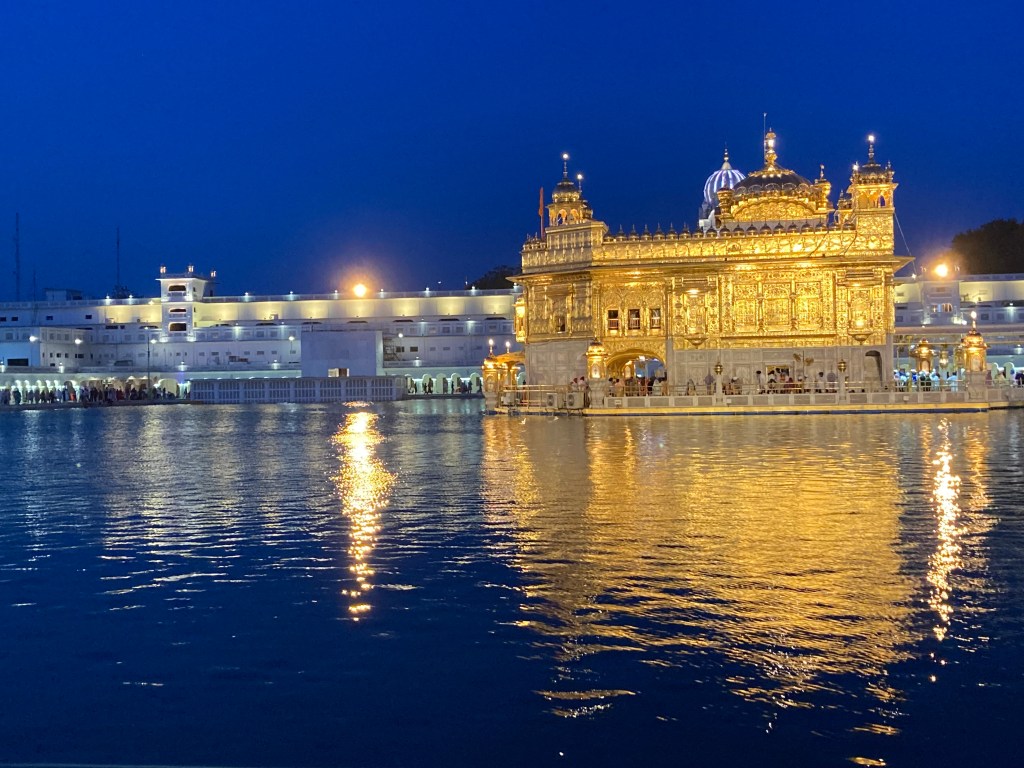
With the chaotic India I know and love loitering just meters beyond this walled compound, I stand with feet braced on marble slabs radiant with the morning sun. Undulating water captures the reflection of Amritsar’s Golden Temple, bewitching its leaking image to manifest magnificence greater than the structure itself. Mesmorised, I weep … viscous tears that stick to my eyelashes and blur my vision before, ever so gradually, building momentum to slide down my cheeks and settle at the corners of my mouth. 

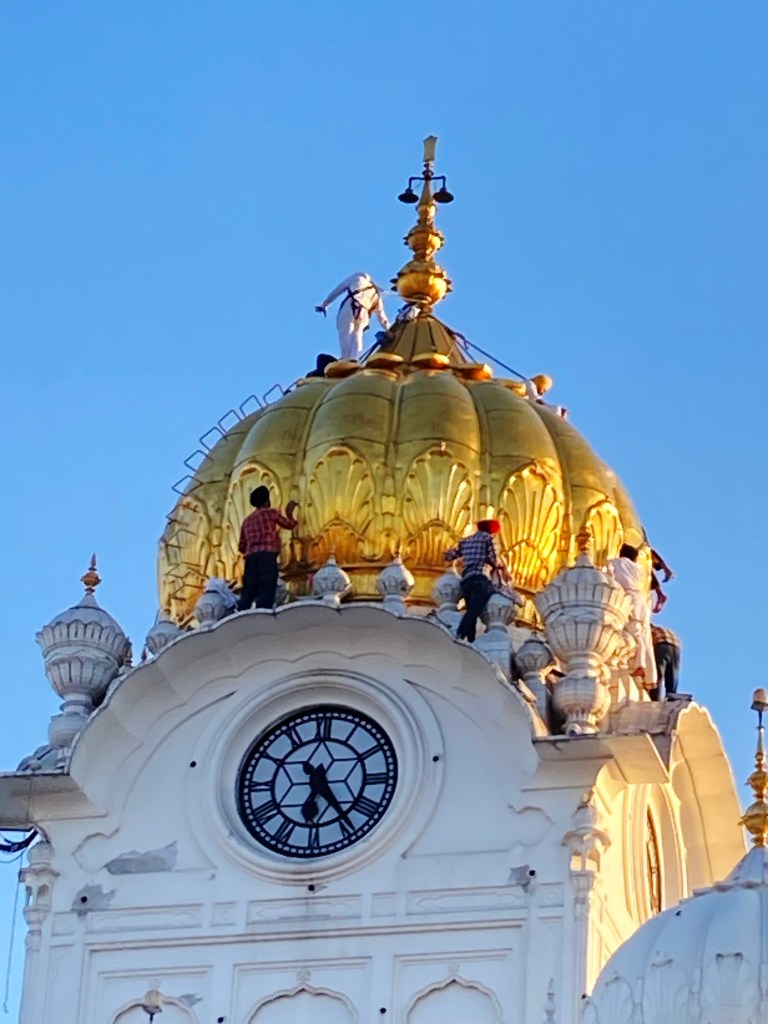
Gu means darkness or ignorance; Ru means elimination of that darkness; Guru means light coming from darkness, and Gurudwara is the doorstep of the Guru. Amrit means ambrosia, a substance so aptly reflected in the name given to the body of water that, bar a 65m causeway, maroons the Seikh shrine crowned with a 500kg gold-coated dome: Amrit Sarovar. Simply looking at it floods me with a somatic response that hitches me to everything beyond the soma.

If water holds consciousness—or, in fact, is consciousness itself—then this temple amrit, where literal millions of people have come to bless and be blessed, is so much more than the sum of its parts; more than the sum of the pilgrims, devotees, travellers and nomads who plunge themselves beneath the surface of this sweet nectar to emerge, reborn.

Travel, for me, is like pulling a treasure chest out of the depths of the ocean. It is my rebirthing. All things both delightful and frightful; shiny and shocking. Covered with barnacles, seaweed, and throttled by umbilical rope, the treasure is locked away with rusted chains, seemingly impossible to access. Yet there it is, and the only obstacle to gold and jewels is reluctance, resistance, fear and ignorance. This is the growth point—the crowning—adapting through a myriad complex situations to bring new clarity.

I stand at the door—on the limen—to my inner guru, seeking the gold that only I have the capacity to alchemise. The treasure is the deep inner landscape of putrefaction; the transmutation of lead to gold with each step, thought, emotion and prayer. Yet, like my tears, water has the capacity to both obstruct and clear one’s vision. And so I too must annoint myself with this ambrosial amniotic fluid so I can bust open the rusted lock and emerge from the treasured womb of my dreams. 

Like the four or five hours’ long queuing that devotees must do in order to glimpse the holy book in the inner sanctum, there are no shortcuts to the treasure when a decision is taken to navigate the deep work of psychic dredging. If you want to get to the Inner Sanctum, you must be prepared for drudgery, claustrophobia, patience … gallons of it.

Where vision is blurred, alchemy brings insight. The tears that ebb and flow—the nectar-like medicine for my soul—this ancient wisdom claims, are the crystallised thoughts that life and love can trap. A holy dip strips me naked, to the bone, layer by karmic layer. Never gentle … always strong … water can cut grooves in stone; can rupture mountains; can ratchet open the mind and return its forgotten essence to the curl of the upper lip, where the tongue can catch a glimmer of it’s wisdom … a cyclical flow of watery tears to saturated consciousness awakening my psyche. A re-cycling; a re-viewing; a re-membering. In unbecoming, I become it all.

If the SriNagar lakes are for me the primordial fluid, and the tunnels through the mountains back into India, the birth canal, then Amritsar’s Golden Temple is the ritual purgation that prepares my new soul for incarnation. I use the experience of my body to access the inner dimensions of my being—my ultimate and quintessential source—to perpetually step up to meet my dreams … because it is only the wise who recognise that their dreams are always on their side.

The heart doesn’t wrinkle. Emotions grow only more fine with age. The mind surrenders. And the soul wisens and expands beyond it all. 

As I step into life, I get lived. As I live, I become life itself.

Eleven: The Dream

“a dream
there should be somewhere on earth,
a place which no nation could claim as its own,
where all human beings of good will who have a sincere aspiration,
could live freely as citizens of the world and obey one single authority,
that of the supreme truth;
a place of peace, concord and harmony…”
The Mother … (had a dream)

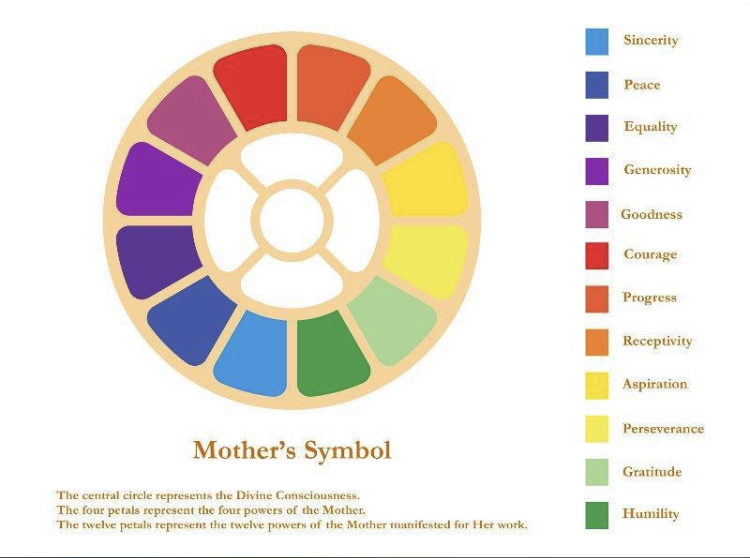
A dream is a portal. So too is a nightmare. Chaos and order both are portals. Auroville was that dream. And Auroville is that portal.

When my son finished school he chose to go straight into his studies. I’ve claimed his gap year. Has we slipped dimensions. Cause. Effect. Unlawful Degree by Distinction. I extend my stay at the sublime 4 East Coast Home and book a flight to Delhi for the 8th of February and a flight to Dharamsala 3 days later. Movement can come incrementally. I am exploring options to stay till July… or August … or forever. Will either of us make it back. Is back even an option. Forward is also an anomaly.

Most people dream of a life that is a dream, an illusion. Some dream of a life grounded in reality, in humanity, in freedom and in truth. I’m settled and decide to stay that way. I’m well and happy and finding ways to recalibrate. I have my moments … but they are more like salt in a lake here than salt in a glass of water. 

For me. The forest is the portal. Running is my vehicle. I am curious about a path but lack the courage to take it. Yet. I run through a spiderweb. That too is a portal.  Superhero. I run. Step by step … no other way for now. Spiderverse awaits. I see a mongoose … My eyeballs search my brain; looking for the plural. I run some more. Everything… the good, the bad, the beauty and fear … comes in plurals.

Altruism is not necessarily grand gestures of generosity and service; altruism can be as simple as being happy and, in being happy, holding happiness for those around you. Sometimes the greatest gift you can give someone is a smile. Sometimes moving a fallen branch from the road or stopping to treat a fallen scooter driver. The paths are dry and sandy. I stoop to retrieve a shoe on the sandy red dust road. Croks it says—erroneously spelled brands come cheap here. I place it on the foot of the small boy who dropped it riding pillion with his mother. A hybrid Cinderella portal to that time way back of wedding sari buying and Nic back-to-back with me on the moped, shouting, “go fast over the next speed bump, Mum, so we can get more air!”

I pass a field of boys playing cricket, pausing to slip into the many memories of four, six and seven-year-old Nic on his Indian cricket tours; playing on the ghats in Varanasi, the town square in Darjeeling, parks and beaches in Goa. I remember the excitement at the IPL in Bangalore and how content he was joining in every cricket game we passed and jumping on the backs of motorbikes with my young colleagues in Auroville for daily cricket games. A part of me wishes he were here and I was studying law.

Space time glitches with precision. Looking for doorways … trying to draw them into my objective reality. Will I still be writing on the other side? For three consecutive days on my forest flings, the same ancient cyclist dismounts his equally ancient cycle at the exact location as I approach in the opposite direction; the same bare-chested Korean teenager runs past me at the exact same junction, and the silver moustached man in a saffron hoodie gives the same steely stare as I cross the new road lined with the remains of the trees. The Chainsaw Massacre was banned in the same era as the birth of Auroville; another thread tethered to inception.

When I recognise the anomaly, it stops happening. Am I through, I wonder. Are you still reading this?

Wild boar sandpits keep me moving forward. I run. The portal to a memory of reading of Ulysses’s wild boar scar on the morning I later encountered a wild boar trapped in a wire fence … human-made in conflict with nature. It is also my trail of crumbs to Penelope in waiting. I can’t stop. My sweat evaporates only when I’m in motion. I stop. Mosquitoes land in clusters on exposed flesh to suck my blood. My edges blur with the steam rising off my body and the mosquitoes drown. Sweating blood, words are like threads through blisters.

I pass the Youth Centre, aging and not yet wise. Perhaps I am straddling the time warp; gradually dissolving across the threshold. My toenails blacken and I run some more.

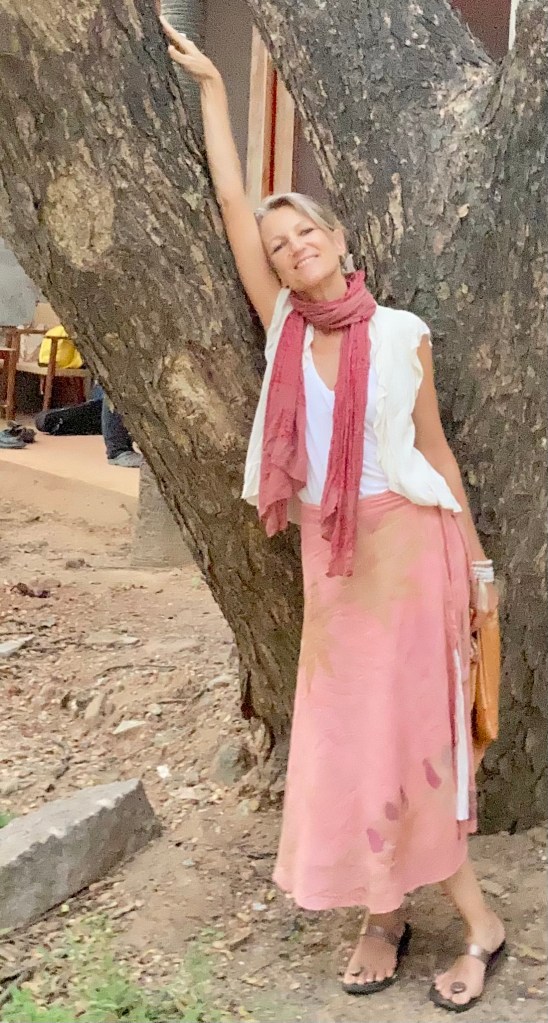
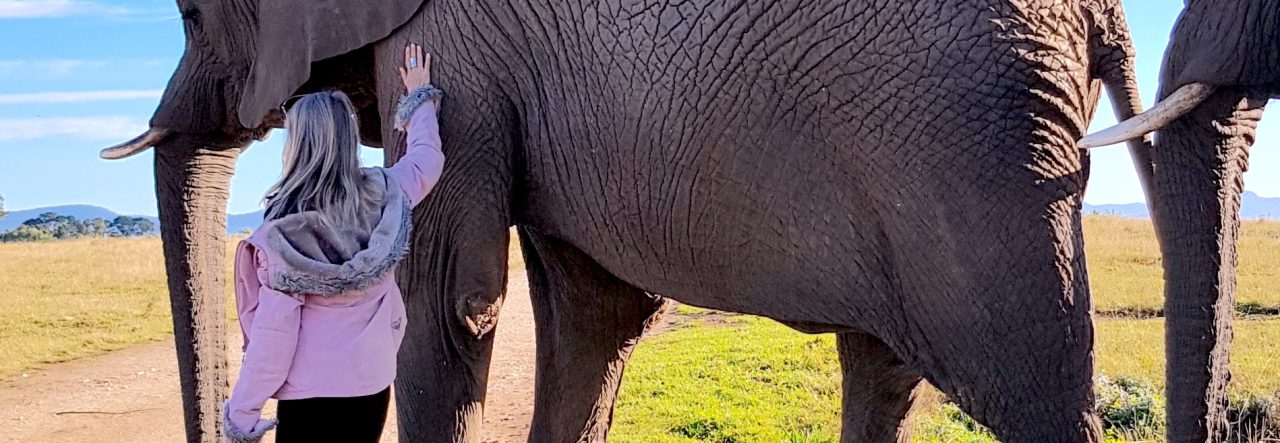
Feeling stuck in a Philip Pullman novel, I remain on the limen, crouching, my daemon beside me. An elephant. Too heavy to carry, this elephant guide crouches beside me, Diana on her back, my real mother and guide—both creature and human. Both. Because everything travels together. In tree pose, she joins the forest, passive activist; ever-present. Compassionately mothering me into the adult who knows who I am and who isn’t afraid to be the Bohemian she was.

As the sun snaps open its brazen eyes and seeks me out between the silences, leaves spray dew, christening my passage through this puzzling tunnel. I don’t look up, It smacks of ambush. I keep looking over my shoulder. Paranoid South African. It sounds like I am being followed. It takes me a couple of runs to figure out it’s the sound of the nylon running baggies I borrowed from Nic shloofing together between my thighs.

I encounter a herd of cows. They block the path; look docile. But I am wise. I back away, remembering the cow in Varanasi I got too friendly with that horn butted me in the solar plexus; left me breathless and unable to call for help. Some things are more scary than they seem.

Everywhere puppies are suckling. Calves too. The puppies stretch themselves to reach the mother’s teats. The calves contort. If humans had to suckle a cow, I wonder, would they still believe they need its milk. Cognitive dissonance. A herd of goats freely graze, stretching as they do to reach things partially inaccessible and I am taken to the Annapurna mountains of Nepal where the sock-eating goats stretch to reach trekkers’ laundry.

If the tree represents the forest, the road represents humanity. The trees will not get defeated because they are not at war. Holotropic breathwork masters. They know we aren’t yet able to breathe. We fight instead … and burn. False breath, false transformation. We fight because we fight the ignorance we neither desire to confront nor change. The opposite of caring isn’t not caring; the opposite of caring is caring too much. And like a heart breaking doesn’t destroy the heart but only opens it to more love, the trees collude with the elements and the creatures to ensure their seed spawn travel beyond this imagined utopia. The trees don’t fight back. They lift their roots like Ents and retreat to safe haven, a simple manifestation of a current incarnation in wait for the roads to crumble to dust. They trust we won’t last forever.

A man squats in a field; his morning constitution. He holds a newspaper—read and wipe. My sari-clad being makes it into the Hindu Bureau; I feel a sense of relief it’s only online. A dog shits on a speed bump—I share the sentiment. The bumps and dips in the roads, like the bumps and dips in life, build my resilience through the bruising and the pain. I learn to put pressure on the pedals when I ride the potholes so I don’t break my vagina.

The light rain has done nothing to settle the red dust. Everything steams. It’s humid. I crunch the dirt thrown up by motorcycles, cows and construction vehicles between my teeth.

I take refuge in the trees. I offer my love. I breathe. The trees breathe back. I sing with the birds. The temples sing in response. Life is a chant. I spiral in birdsong and shade. And from the villages beyond the trees, Bollywood blasts from a megaphone and my body moves in synch. I dance in chaos and move to flow … and back again. Both polarities can reside in harmony; a harmony borne only through the portal of conflict. Order leads to chaos and chaos will ultimately always make way to order. Harmony isn’t calm … harmony is about being able to move between it all and not get lost in the clinging onto just one aspect of the entire range. Order is safe but chaos brings change. Within everything is the seed of its destruction. Struggle always manifests new life, generates resilience.

Post a 4-day water fast (translation here is 4 days no water as opposed to the 4 days only water that it is) I choose an integrating walk in the forest. I see a runner in the distance. My competitive subconscious kicks in. I run to overtake him. Podium position. It feels simultaneously pointless and fun. I get my dopamine where I can. Not running away from anything. Running towards everything.

The head of a kid goat lies with a vacant stare on a roadside table, its severed body already butchered, more distressing than butchered trees. Trees grow back, goats don’t. Nearby, an old goat sits on its concrete block not wanting to move where the rope no longer tightens around its throat. The other side is tied to a tree, beneath its branches a shady patch of grass. It reminds me that I too feel like I am tied to the branches and pulling away despite it throttling me. At the end of my tether. How often do we tie ourselves to that which seems to bring comfort only to find we are strangled by our own knots?

It takes 2,979 hours to walk to Japan and 1,850 hours to walk to Bali. My journey stretches out like the thousands of steps and I feel such liberation in my diminished attachments and in not being missed. I won’t be returning as planned on 11 April. I won’t be walking to Japan or Bali but I will be flying to Kathmandu. They offer a 90 day visa and I’m thinking it would be a waste not to utilise all 90. My work is loved here; I feel I am too … both appreciated and received … but I must leave. Some aren’t ready to heal. The trees have spoken and I need to let the dead leaves drop so the new can grow; I need to expand my branches and drop aerial roots so I can expand outwards to provide more shade for those who need it.

The world that I am used to is gone and I am on the limen of finding the new. I buy a magnificent scarf emblazoned with golden dragonflies and when I reach my bedroom door, there is a dragon fly clinging to the string tied to the lock. It flies in after me.

Reminiscent of clearing my storage after four years; moving only what was absolutely essential into the house I built, so too have I cleared my inner storage containers and what I now put back in is what will stay and sustain and support.

I have become the woman who would have taken care of me as a child. And now I take care of the me I have become through the portal of travel.