Back to the Future

My future self; the one I am becoming; requires a re-viewing and re-weaving of my past. This re-creation of my past versions re-create the person I am in the present. This current re-creation is for the sole purpose of living in the present in a way that prepares me for who the future version of me needs to become … in order to re-create the past version … in order to live more fully as the person I am now … in order to prepare me for the person I am becoming.

This is an infinite cycle. In order to leave this life for my next incarnation, I must tie up the threads to complete the shroud so it is ready for me to take me to the other side and prepare me for the next lifetime.

There is a lot of talk about re mothering parts of your self. I didn’t have a good mother figure in my mother so I use my paternal grandmother, Diana, to fill that function and I use my own mothering of my son to remodel what I received. In doing so I change the vantage point and feel nourished by using this future reframe to rewrite my narrative. The same happens as I guide youngsters to build healthy relationships. It’s not going to change the abuse but it is going to create the spaces that allow the traumatised parts of myself to heal my future self (which informs the past I can see … is it making sense yet?). I am in my present being mothered by the future self who has me in her sites just as I have my past self in my present sites. The focused crosshairs are also threads of the sniper fire that assassinates the versions that must die.

And it all happens in the chakra of unconditional love: the higher Heart Chakra. As the lower chakras evolve and grow up through the density of physical matter and the light of our higher power comes down to transmute it, the meeting point of the infinity symbol is the beating of the heart, where life emerges from the seeds planted. 

Pushing away the things you don’t like about your past means also pushing away the things you like. They are woven together. Packing everything in the past where some people say it belongs is counterintuitive. Whatever you don’t process or integrate rules your life. The past travels with us. Either you keep looking over your shoulder as you run from it or you stumble and fall trying to chase it, or you hide under a rock so it doesn’t find you, or you stake it and carry it like a banner or white flag. Or you can look at it, befriend it, integrate it, and allow it to live within you as that part of you that reminds you of what you have experienced. It has to be identified and grieved and then projected as a healed version back into the future. 

Letting go isn’t forgetting. You can’t forget a memory. You can have a lobotomy or develop Alzheimer’s Disease. You can cauterise a bleed but not an emotional pain. You can work in a way that gives you full sight of the memory and with wisdom, clear vision and honesty, you can work in a way that allows you access to the story without all the emotional content that takes you into the trauma. Letting go of the bad memories requires letting go of the good ones too. Equanimity is about seeing both bad and good as equals; both as parts of the same tapestry that makes you who you are. Letting be is like keeping the memory and not getting tied up in it. Remember without the charge, the triggers, the amygdala hijack. Remember with the wonder, the intrigue, the anticipation. I once remembered with trauma … after Gavin, all my shadow content bubbled out of me like little demons. I felt possessed as I recalled the lies, the heartbreak, the manipulation. I wanted him to care but in hindsight I’m lucky he didn’t. Because I could allow it all to spill out of me and I could rage against the ghosting and I could purge my darkness … and all of it went nowhere; all of it fell on the emptiness of being abandoned and then ghosted. It’s a grim reality that ultimately saved us both. I thought I was going mad not getting closure for being thrown away like one of his discarded books he got to read, integrate and then toss in the recycling. It wasn’t so much that he had turfed me after taking all he could from me; it was that it triggered my lack of belief in myself … a feeling that people want only the illusion of me and that once they get to know the real person behind their idea of who I am, they find me inappropriate and too much and decide to choose something easier and less real. Life is full of irony. There are few people I have been really real with … like really real. I am now authentically myself always and yet I only show parts of myself at any given time. This makes it easier to be really real but in smaller more manageable doses. Not for myself but more for the people I am engaging with.

Like the quintessential philosophical dilemma:
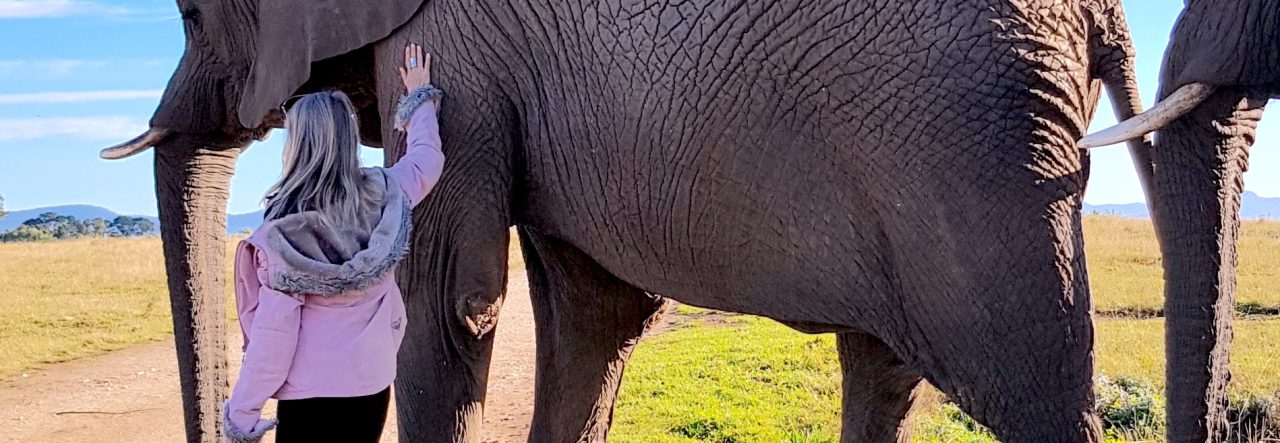
How do you eat an elephant?
One bite at a time.
The Scapegoat

This topic is highly relevant for millions of people—nothing any of us goes through is unique to us—and relevant to me in the context of having thought the dragon had passed and then getting caught and thrown temporarily off balance by that final flick of its tail.

The ones who demand forgiveness after hurting you; the ones who criticise you for having boundaries—who tell you said boundaries harden you; the ones who project their unintegrated anger onto you in the form of poisonous verbal and emotional abuse and then tell you it’s your fault for not being ‘spiritual enough’ to keep taking it … they are the ones who benefit from your always having been the scapegoat; the ones who benefit from your resilience to not react; the ones who rely on your not having boundaries.

The ones who tell you ‘I just want you to be happy’ are guilty of gross manipulation sending the ambiguous verbal message that they are entitled to use you as a punching bag and make you the guilty party for your not being happy for it … because all that passive aggressive message says is that you are responsible for their happiness … the double whammy of gaslighting!

They are so lost in their own cognitive dissonance that they need to make someone else responsible for their unresolved shadow. And the longer you remain in the scapegoat role—because, honestly, it can take decades of sucking it up to keep the peace before recognising you are perpetuating the dysfunction—the deeper into all the layers of your being the disease will sink … until you have to choose to heal or die.

And when—or if—you choose to fully heal by removing yourself as their scapegoat and to instead tell the truth, it’s going to get a whole lot worse before it gets better. 

The less you react the less justified they feel to maintain the abuse. The vitriol will increase and the accusations of your so-called instability will increase. Because they need you to react so they can use your reaction to justify their behaviour … because they really can’t accept any kind of blame—that’s your role, remember.

Remember—please!—that you have done nothing wrong. You are not responsible for making them feel better about hurting you. You are not even responsible for forgiving them—because that would require them admitting fault, being accountable, and changing their behaviour. You are not responsible for making them understand this. The ONLY thing you are responsible for is healing.

It’s ok if it’s taken so long to recognise you have enabled this; it’s ok to be angry and indignant and to want it to be different. If there is any place for forgiveness it is in forgiving yourself … and to keep forgiving yourself. You are the only one responsible for your own changed behaviour and the only one who can live your own life with your own true self. Mostly the abuser is perpetuating their own cycles of karma and abuse … mostly they are emotionally inept and incapable of integrating their shadow self. Mostly hurt people hurt people. 

You have been made to feel you are helping them heal by being the scapegoat for all their own wounds. You are not responsible for fixing them. You can only fix yourself. You are the only one who can stop the abuse by removing yourself from the abuser.

While they turn you into the perpetrator for not taking responsibility for causing them to hurt you; while they create stories to make you the crazy one, the broken one; the mean one; while they spin the cycle of their own personal drama triangle and blame you for their self-inflicted crisis of the soul (which they obviously don’t recognise as such while they are still in the echo chamber of their own delusions)… while they shame you for not ‘taking the spiritual line’ that enables them to continue being abusive … it is up to you to: Stop the cycle of hurt! 

All these things they perpetuate are not yours to heal in them.
You can only heal those parts in yourself that they are karmically activating.
It’s up to you to break free of the drama they have staged.
It’s up to you to not be a hurt person who hurts.
You are the hero of your own story.
Take your own shadow.
Get off the stage.
Step into your light.

The 5 Symbols of the Camino de Santiago, Part Five: The Scallop Shell

Symbolically the shell is from the ocean and is linked to Venus (self love). It is the so-called medal at the end of the journey once the shore is met and one is able to baptise oneself in the salt water and become new once more—like a baby, and with unconditional love for self.

The way it ties together the network of support is that its image is used as way markers along the route, marking the way through landlocked villages and cities in the hopes of—in days or weeks or months time—the pilgrim will reach the end … which is also the beginning.

It is not only an inner and outer totem of the achievement of the completion of this particular pilgrimage, it also denotes an opening of the heart and a vessel from which to gather water to drink or anoint oneself. It is also used to ask for donations of food and money.

Sometimes building self kindness can be through random acts of kindness to others. Showing someone else the way can be a guide for self awareness and more adept self trust, self love and self guidance. The notion of offering a helping hand draws attention to the focus on the work I do with my hands and how that reflects on how to give—but not too much of myself so as to not become depleted—and, with the same open hand, to receive what I need from others.

The lines on the shell are known to represent the different routes taken by the pilgrims so, having this as a source, we can trace our different narratives with the outlook that there are many pathways to the same destination and the goal is in the experience itself. Being open and aware to the needs of others is the beginning of a journey home to self.

Questions to ask yourself:

  • How did I stay open and flexible to changes in the direction my day took?
  • What are the inner signals of courage I can pay more attention to?
  • How did I engage with and harmonise giving and receiving?

The end of one journey is always only the beginning of something else so there can never be any expectation of finality. Life is only what you can hold in the Scallop Shell.

On this pilgrimage, because I am walking to raise awareness for mental health and will be intentionally working with people who approach me for coaching, meditation, therapies etc, I will hang a donation box from my backpack with a QR code that pilgrims can scan to access my socials, the work I do and the cause I am walking for. This is aligned to the scallop shell which can also be used as a begging bowl and I am doing this as a way to break down my ego as I open myself to receiving donations from strangers like a nun. 

You can follow, support and share my Walking for Mental Health fundraising campaign on BackaBuddy. All my socials can be found on LinkTree.

The 5 Symbols of the Camino de Santiago, Part Four: The Bandage

Joseph Campbell said, “Follow your bliss”. Pilgrims follow their bliss/ters.

On no past Camino de Santiago or long-distance local hike have I had to deal with blisters. The only trek I suffered from blisters was in 2001 on the Annapurna Circuit (Nepal) when I walked in leather boots I took out of their box to pack in my backpack … I didn’t walk in them once before boarding the plane to walk for 21 days across and over the Himalaya at 5,400m altitude.

Symbolically, my life in 2001 was plagued with abrasions that caused more pain than pearls and by 2016, my first Camino of 250km with my then 11-year-old son, I had recognised and was acting on my need to nurture my wounds.

Some people diminish their wounds; some deny them; some go into a trauma response and simply obliterate them from memory; some defend their wounds and use their pain as a badge of honour, and some just never quite manage to shine because that would mean giving up on the psychic injuries they have been subjected to.

Adapting to different footwear—I now wear Altra trail running shoes for Camino and will be wearing T-Rockets running sandals on some days too—and conditioning my feet long before the journey, as well as every day before and after walking, is a good analogy for building capability and competency to face challenges … and also to recognise where the stone in my shoe is going to hinder my journey and where the stone in my shoe is the grit that the oyster uses to make the pearl.

It is erroneous to bandage and splint healthy body parts, so there is a call for discernment in how one treats one’s wounds, both from the past and those that present themselves currently. Self-care can reprogram one’s emotional, physical, psychic and mental bodies to engage differently with personal injuries or traumas and shift perspective from being overcome by wounds to using them as a pathway to healing.

As I walk this journey from next week, for Mental Health I will be intentionally working with fellow pilgrims who approach me with specific needs around grief, loss, trauma and dis-ease and I am cognisant of needing to be discerning in how much self nurturing and self supporting I must do in order to be able to support others on their unique walk to wellness.

We are not here to be perfect, we are here to heal. And the first part of any healing process is to recognise the wound as a symbol of healing rather than as an obstacle in its way. It’s important to not get too attached to the strapping and then fail to acknowledge that the wound is no longer there. Struggle can be used as a tool to justify one’s actions or one’s suffering and to eliminate the need to step up and show up. A wound isn’t a life sentence and a bandage isn’t a ticket to victimhood. Letting go of the identity of injury can be empowering and can create the space for taking on the responsibility of stepping fully into one’s essential self.

Take care on the journey by training well in order to diminish the risk of injury and by also preparing well by carrying a first aid kit.

Questions to ask yourself:

  • How do I grieve whilst supporting others through their struggles without comparison?
  • How do I create discernment between compassion and a bleeding heart?
  • How do I bandage the internal wounds that hurt more than anything that bleeds?
  • How do I relate to past wounds, injuries and traumas on an emotional, physical and mental level?

You can follow, support and share my Walking for Mental Health fundraising campaign on BackaBuddy. All my socials can be found on LinkTree.

The 5 Symbols of the Camino de Santiago, Part Three: The Yellow Arrow

It may look like the same route as the hundreds of thousands of pilgrims before you yet it is different for your walking it. A pilgrim’s unique footprints make for a unique pilgrimage. 

The Yellow Arrow is a sign of reassurance that one is following one of the routes on the pilgrim’s way and is an iconic symbol of direction in one’s life as well as ancestral direction and rites of passage—pointing out A way which is different to THE way. 

When finding and following these markers it’s a reminder to honour those who have come before. There is a ritual to walking a path that many have taken before, honouring them for carving the way and then honouring oneself for creating one’s own journey from the way. There are many paths leading individuals back home to themselves.

A well-trodden path is still the path untaken until one actually takes it … and then one gets to make it one’s own. It is important to get lost in order to find my way and there is a particular practice of non-judgemental observation that comes with the acceptance of this. I feel it’s important to find myself in a place so unfamiliar that I am challenged to work out how to come back to myself or to accept the new place in which I find myself.

Every part of the entire universe is already right here in this one moment … this one step. There is no manifestation magic in life; it’s all about showing up and placing each foot down with attention and intention. In alchemy it is the third stage in the process, Citrinitas, which is the stage of education before Rubedo, the stage of transformation.

The present moment is your refuge, and this is your home … each footfall brings you back to your self and each self that footfall brings you to is changed because of the footfall. Each contour is as unique as the contours on each individual’s thumbprint; each arrow perceived as just a subtly different shade of yellow; each vista viewed with new eyes; each drop of dew a different prism of light. 

Stepping into each moment builds awareness of what’s in the way, where the path is leading, how open you are to your intuitive GPS, when to follow outside signs or inner cues, when to change direction etc. Trust in self appears in the showing up without knowing where the path goes but recognising that no matter where it goes it is going somewhere and it’s ok to adapt along the way. It’s impossible to be ready for every eventuality before a journey but it’s possible to be prepared to be resilient enough to figure it out on the way. To be able to flex into the curves and detours of any journey is a skill we can develop through recognising that there are over seven billion unique humans and, therefore, over seven billion unique paths.

Questions to ask yourself:

  • Where did I lose my way?
  • How was I able to find my way again, find a new way, or ask someone to guide me?
  • In the moments of getting lost how did you recalibrate to a new way by asking for guidance?

You can follow, support and share my Walking for Mental Health fundraising campaign on BackaBuddy. All my socials can be found on LinkTree.

The 5 Symbols of the Camino de Santiago, Part One: The Backpack

As I embark on my most challenging pilgrimage, 1,000km on the Camino de Santiago in Spain, Walking for Mental Health, I am drawn back to reflect once more on the symbols of The Way that I have previously walked with.

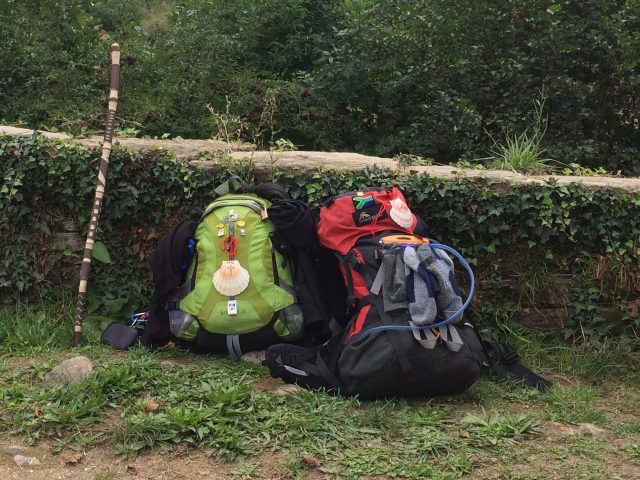
The first symbol is the most important for me as it indicates the strategic part of the planning phase as I consider what to pack … adding and then eliminating … ruminating and deliberating … trying to envisage the climate, the landscape, the skin feel and mostly—perhaps obviously—the weight vs the comfort of choice.

If a backpack is too full, the physical body will be strained over capacity and the mind will be less focused on the path ahead as a consequence of the pain. Carrying an extra weight on one’s shoulders has become normalised and it’s common for people—adults, children, corporates, healers—to be brought to their knees by this weight before asking for support. Equally, the journey can be hindered by too light a pack as a result of not paying enough attention to the necessary items one needs to carry on a journey; this could also indicate a—conscious or unconscious—negation of certain personal needs and basic requirements for comfort and health.

We all tend to accumulate too much, often out of fear and death denial; a habit that is hard to break and one that ultimately results in being unwittingly burdened with more than we can carry. It’s important to see what and who lies beneath the layers we have built around ourselves and the burdens we have chosen to carry, and then to create new habits to do with shedding rather than accumulating.

To strip down on an emotional, physical and mental level takes courage because it shows us our authenticity and the corresponding vulnerabilities. By stripping down I don’t mean full renunciation; I refer to discernment around needs according to values and a slow un-layering in line with each person’s capacity and desire for transformation.

Questions to ask yourself:

  • What am I carrying today that may not be mine and/or what is the impact for me?
  • What can I remove from my backpack, and who, if relevant, can I give it to?
  • What’s essential that I might add or that would be worthwhile adding to my backpack for now?

Observations:

  • Awaken your ability to recognise when, how, where and for whom you may be over-burdening yourself. 
  • Build your capacity to feel into how your whole system is responding to the weight you are—intentionally or unintentionally—carrying on a physical, mental and/or emotional level.
  • Look at what doesn’t need to be there as well as what is potentially missing that will benefit the pilgrimage and ease the long walk.

You can follow, support and share my Walking for Mental Health fundraising campaign on BackaBuddy. All my socials can be found on LinkTree.

Believe yourself into Being

When people believe in you, you start believing in yourself.

I grew up not being believed in — my skills and abilities and also my innate wisdom were overlooked; considered odd — and I consequently learnt from a very young age to abandon myself to fit in and be fed.

I am not a victim to this because I also know the wound is the gift.

So my life’s calling, and my ultimate answering to it, has been to value people and help them heal enough to believe in themselves again.

I have found in life that there are two times where people get abandoned in the type of society we now live in where attention spans are diminished and judgement trumps trust: when at our absolute rock bottom having lost the ability to don the masks of an expected norm, and when in our blissful joy living in alignment with our purpose and meaning.

There are always those champions in life who hold you in support and believe in you at both ends of the spectrum — these are your people; hold onto them … the ones who only hang out in the middle zones only erode the belief in yourself you have worked so hard at regaining.

The loneliest of people aren’t those who have no one around, they are the ones surrounded by people who don’t share values and who expect you to show up in service of who they need you to be.

As Michael Mead says, “The calling keeps calling.”

It is never too late and you are never too old to become who you were born to be. Depression, addiction, anxiety, stress … to name only a few afflictions of this world we live in … are the silent killers that need to be witnessed and brought into the light by those willing to go into the dark.

I have found that when life is so hard I have lost the capacity to help myself, I go buy a meal or a blanket for a homeless person or pay for street people to spend a night in a shelter. This is my medicine—an unwitting and relatively minor altruism and the one that has had the power to keep me going until I believe in myself again.

And then I must dance … because dark and light have to be navigated in equal measure for the psyche to find true harmony.

Namaste 🙏

I am in Cape Town until October practicing in my Hout Bay therapy space for Craniosacral Therapy and Coaching; on the mountains for Meditation and Hiking/Running, and online for Coaching and 1-on-1 Yoga and Meditation.

All of my modalities can be combined into half or full day group or individual retreats.

A little background:
I have a passion for holistic health and non-prescriptive self development. I believe in an integrated patient-centred approach to personal transformation and will take each individual on a journey to their own unique place of innate health using a variety of modalities.

These include: Craniosacral Therapy, Integral Coaching, TIME Meditation, Transformational Yoga, chakra purification, nutrition and personal psychology. A summary of modalities and costs is available at https://wellworthbeing.com/costs/

Our bodies are the vessels of our current existence and have an innate intelligence that we simply have to get in touch with in order to live well. Each body has its own stories; my job is to listen – to hear its stories as clearly as possible – and to respond effectively. I work with health, not illness, basing my therapy and coaching sessions on what is inherently well with your system as a starting point and we build from there. 

Through bodywork and coaching sessions I re-establish the dialogue between your body and its inherent health and guide you to the best version of you that you can be. What you will get from a session with me is a 100% commitment to your wellbeing. I show up with curiosity and an open heart and allow my expertise, experience and intuition to guide each treatment.

Whether I am treating an individual or guiding a corporate team or school group, I bring the some dedication to the containment of the space and the transmission of information, knowledge and wisdom.

Contact me at wellworthbeing@gmail.com
or
WhatsApp on +27 74 1011 621
to book your private or group session(s).
You can also buy a voucher (or five with a 15% discount) to gift to loved ones.
Please share my website with anyone you feel may benefit from my work.

Namaste 🙏🏼 meaning:
The divine light within me bows to the divine light within you. It is a greeting used as acknowledgment of seeing in you what you may not see in yourself and to use that as a mirror to reflect what I too have within me. You can use it while pressing your palms together in front of your heart and this brings mindfulness to breath and the subtle movement of your heart and lungs contained within the ribcage. The greeting done in this way fosters interconnectedness and brings a calm presence to the beginning of any interaction regardless of content.

Twenty Six: Monsoon Bower Bird

“Please speak of how you view the possibility of attachment to non attachment,” I ask the dharma teacher.

I am at Kopan Monastery to heal my body and mind from resonating at the frequency of the fatal diseases I might have contracted from the dog bite, and to recover from setbacks encountered on the home front. On a three-day water fast, I travel the darkened tunnels of a healing crisis with fever and fitfulness and I find the comforting containment of 700 monks and nuns chanting and performing pooja to be instrumental in my wellness.

I notice, as I ask the question, my hand running fingers through the thin blonde hair I have always equated with femininity as I admire the teacher’s beautifully smooth-shaven crown. I am drawn to life in a nunnery and commit to shave my head on my arrival in India … yet I also know how fickle I can be. Life as a renunciate mocks me as I consider relinquishing the bower bird aspects of my identity … the beautiful shiny objects I have around me, even on my travels.

I sit each morning as an observer, an outsider looking in on the monks as they arrive dressed in robes that simultaneously shed their identity and give them one. They prostrate and take their seats. They are vessels, showing up in service to the prayers; chanting for others what others can’t do for themselves.

I sit and contemplate on no more than what I witness. The pooja, the music, the clapping away of evil spirits. When a British Colonel arrived in Lhasa after gunning down thousands of Tibetans, he is said to have felt great pride in the Tibetans clapping for him on his arrival, mistakingly believing their attempts to dispel evil as their celebrating his prowess.

The opposite of doing is not apathy; it’s allowing … a yielding rather than a seeking. Meditation is an action. It is a deliberate and intentional allowing of all that is, in order to practice not attaching to any of it through the sense organs. Gathering to wash the plates and utensils from food preparations, the chatting and community is as profoundly important as the nourishment from the simple food. Quality of life is expressed through moving hands that find their intelligence in ordinary tasks. Is this what malas could be used for? I wonder.

As the fever passes, I feel both relief and disappointment. Relief that I may have healed myself from potential suffering. Disappointment that I may have saved myself from dying. If you know me, you will understand that this is not in fact a depressed dig in the darkness, but a lightening of something quite liberating. Regardless, a little more context may be required for those who don’t know the true meaning of the word GuRu and may be more attached to just the one syllable without considering its counterpart.

I have never felt fully committed to this incarnation. Call it trauma, abuse, nervous system dysregulation … no matter … contemplating death these past days, I recognise that I am more attached to death than I am to life. So the tears I shed are related to feeling that dying from a dog bite in a country that honours death as much as it honours life would be a better fate than ultimately taking that long walk into the ocean when I am done with this so-called me I am becoming less and less identified with as I travel to integrate the past five decades of my fabrication.

There is a middle ground always: not attached to either life or death but fully committed to and incarnated in both. Like a suspension bridge that must be fully rooted in both banks. Straddling. Clinging to neither … and also to both.

My writing habits have gone into holes and tunnels and transcended the notion of linear time. There are gaps … chasms. And, as with my meditation practice, I have to keep coming back to the cushion to start again.

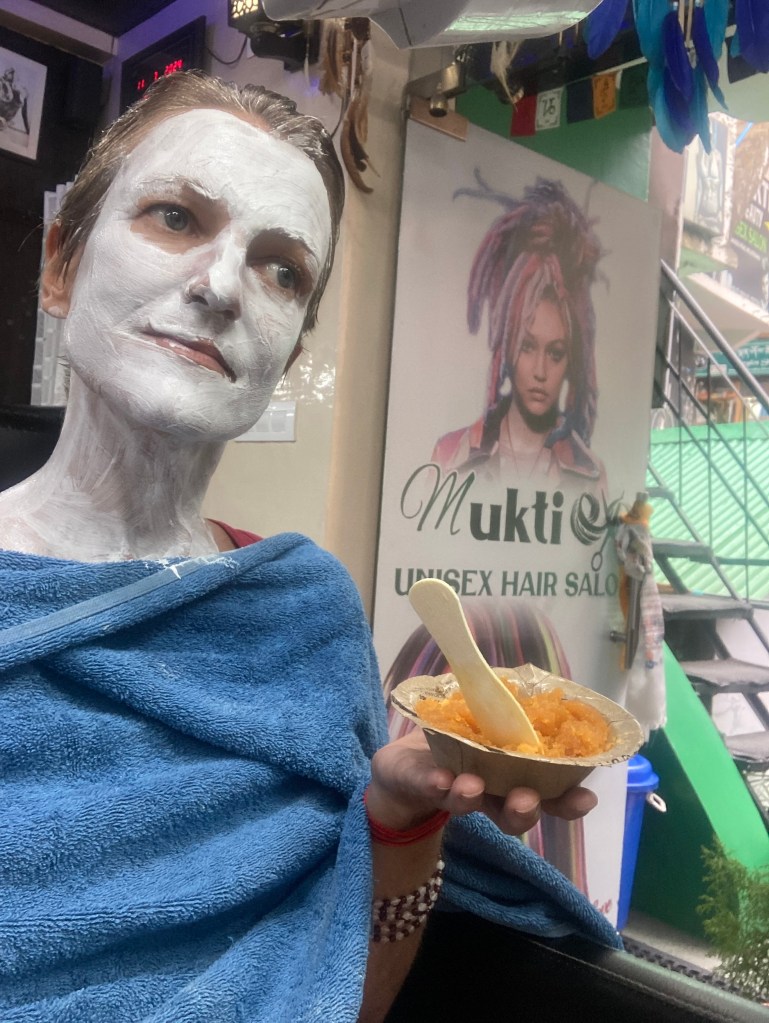
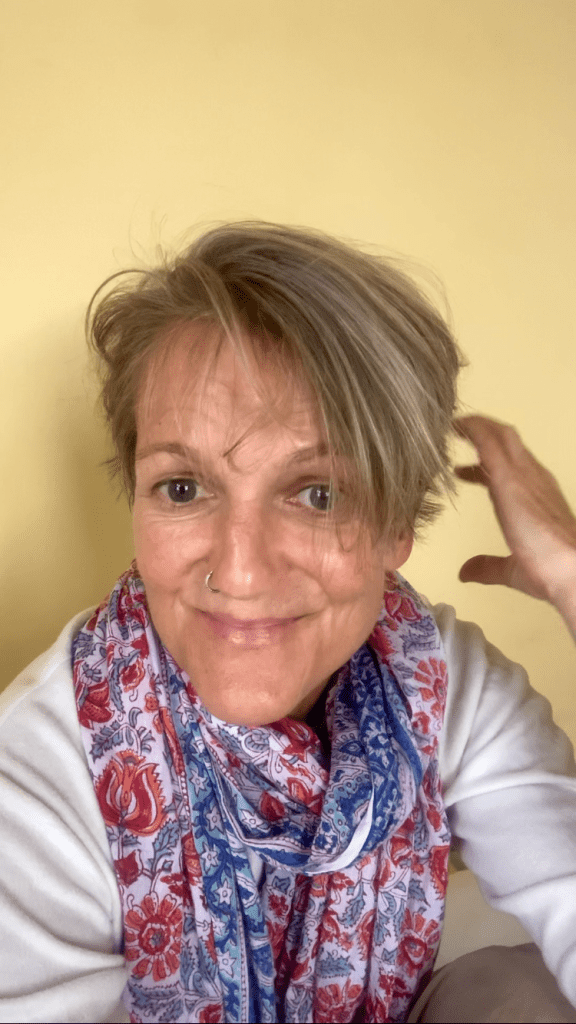
I am in India now at Deer Park Institute in Himachal Pradesh. So much life has happened between my time here in February, and this time now. I have written less than I aspired to, traveled and explored way more than I imagined, connected, studied, expanded (and also contracted), integrated and shed so much of who I believed myself to be. To honour this new version of myself that can’t recognise myself in the mirror anymore, I travel to McLeodGanj, two hours each way by cab, to a hairdresser I met in February. My instruction to Mukti back then was still my usual, “Just the ends off please; I’m trying to grow it”. This time I am not bold enough for the full head shave—yet—but I flick through Pinterest to show him some images that match this new Penelope V11.9 and tell him to work his magic. I close my eyes and breathe.

This is the only death I need right now.

Monsoon season is a flushing of all the rubbish; a cleansing of the earth and a transition into autumn. India has six seasons instead of four … six opportunities to adapt or die.

Ten: Toto, are we Home?

I bought a sari when I travelled through India about a decade ago. I have bought many over the years. They are draped throughout my home as a love sonnet to India and a symphony of remembrance to my paternal grandmother who was born here. But this particular sari is different. Pure slippery silk in the deep cobalt blue you would see in a stained glass window, and woven with pure silver thread, I bought it whilst dating a man I loved. He had spoken of marriage and this was my intended wedding drip. Unable to find it for several years, it was only when packing up my house for this trip that I rediscovered it. I follow the trail of crumbs to find out why.

I depart Sri Lanka in a state of blissful calm having forged more meaningful relationships in a month than I could imagine possible in several years. This maiden visit was not, as I initially believed, eight years overdue but exactly on cue. It contains me. It infuses me. It recodes my DNA. If India inspires my grit, Sri Lanka has been my grace.

The drive from Galle Fort to Colombo International is as slow and mellow as is manic the drive from Chennai airport to Auroville. Psychedelic daydream. Un curated. The hazy persimmon sun hangs between palm fronds tracking the trajectory of the day. A goat runs across the road; its frantic herder throws herself between cars to beat it back in formation. The once comforting and familiar smells assault my nostrils. Human filth molests my eyes. We almost hit a calf. The car lurches. An entire herd takes up a lane on the highway, lumbering, oblivious. Time warps … both linear and spiral … both vertical and multi-dimensional. The sun is swallowed by horizontal smog resting on rooftops. The journey is long; the drive spasmodic. A fairground dis-traction. 

Paving the road to relocate to Auroville has been twelve years in the making and, as my son leaves home—allowing me to create this transition—Auroville is a human experiment in its demise. ‘Paving’ has become a swear word. Trees are massacred to make way for roads, housing, a city of people ready to populate this foreign utopia. I am unsure this still feels like home. But I am suspended in the liminal space between places, external and internal, and I tread tentatively to feel into who I am as a reflection of that.

If Sri Lanka gave me comfort in structured travel, all of my plans for India strangle me. I bite the SriPada white string off my wrist; even that feels like a garrotte. My AuADHD brain causes literal writhing and groaning as I ruminate night and day … sleepless, delirious. It tears open my capacity for worship at the alter of my introspection. Not having been allowed to develop and apply interoception as a child, it is still a struggle in my 50s to discern wants from needs. And as I find myself occasionally still defending my need to travel, I recognise that the intensive course I have sequenced this entire trip around is a decoy to justify taking time out for Me.

Manifestation is directly correlated with what I currently put my energy into, so resistance simply manifests that which I resist. And yet here I sit on that very cusp I fear the most, wanting to change everything about my next few months and paralysed by my fear of making the wrong decision. I’m not afraid of going into the unknown. What I fear most is the not stepping into the unknown … the terrifying prospect of choosing inertia over movement … the feeling into the pause when I have to choose whether to step forward or not … the insatiable courage and curiosity. 

I have spent my life in service to everyone else’s agendas—mother, husband, son—and bulldozed my way through more than the RDA of studies in support of the work I do for others. So, doing anything out of obligation rather than desire has this week become my main gear shift process and priority; a fragile time of subtle recalibration—not wanting to overcompensate and shift too far in the opposite direction … maintaining poise whilst tuning into the silence that still has something to say.

Awareness is, however, only one wing of the bird. I often fly in circles.

I reorientate to—and in—the surrounding forest, looping to begin with so I don’t mistake one red dirt road with another, and then gradually broadening my forays. I reach out to touch the trees. A Mimosa frond closes over my finger; a forest friend reaching back. In the seed of everything is its destruction—a plant, a city, a person, a dogma. As I orientate to my environment I orientate to my Self. It too has the seed of its departure. I take a familiar path. It leads to an unfamiliar field. Am I lost? I wonder. I wander. Everything looks the same. Everything looks different. A creature lurches in the bush; the smell of lemongrass floods my senses. India is a land of distinction and dichotomy. A labyrinthine mystery.

Defined as ‘excellence that sets someone or something apart from others’, the word distinction mocks my equanimity. My son’s six Matric distinctions prove his competency. Confident he will be just fine on his own, one final push and I am solo. Confident I will be too. I pass a sign to Surrender and understand that this is always the very first step in the process of manifestation. It is only in attuning to and creating appropriate conditions that the unfoldment and formation of the foetus can occur. When I open up to what I seek, what I seek will find me. Cows barricade the road. I’ve learned to honk my squeaky e-cycle horn at everyone and everything. Wide-eyed diva eyelashes gaze back. I drive around them. Some things do just need a wide berth. 

Whilst it is seemingly obvious that it’s impossible to survive without also thriving, it’s questionable whether thriving is a feasible notion without the fulcrum of surviving. I regularly throw myself over this tipping point. The love, the hate, the everything in between. When struggle becomes synonymous with productivity and achievement, travel teaches me how to regularly come back to centre. Not permanently; just to feel into the equipoise before the next swing of the pendulum. Expansion and contraction—this is the harmonious interplay of integrating Equanimity.

My itinerary lies frayed on my laptop screen. I piece it together with pliers and superglue, the prescriptive picture on the box no longer the one I am creating. There is another waiting to take shape—I am both creator and student, instructor and imbecile. Struggle is both a personal and universal lack of acceptance. It’s impossible to evolve AND be resistant. Change is like getting caught up in a wave—if I tense up, the force will use my defiance to pummel me; if I loosen, however, I can tap into the water’s power to pop out. To find air. To breathe again.

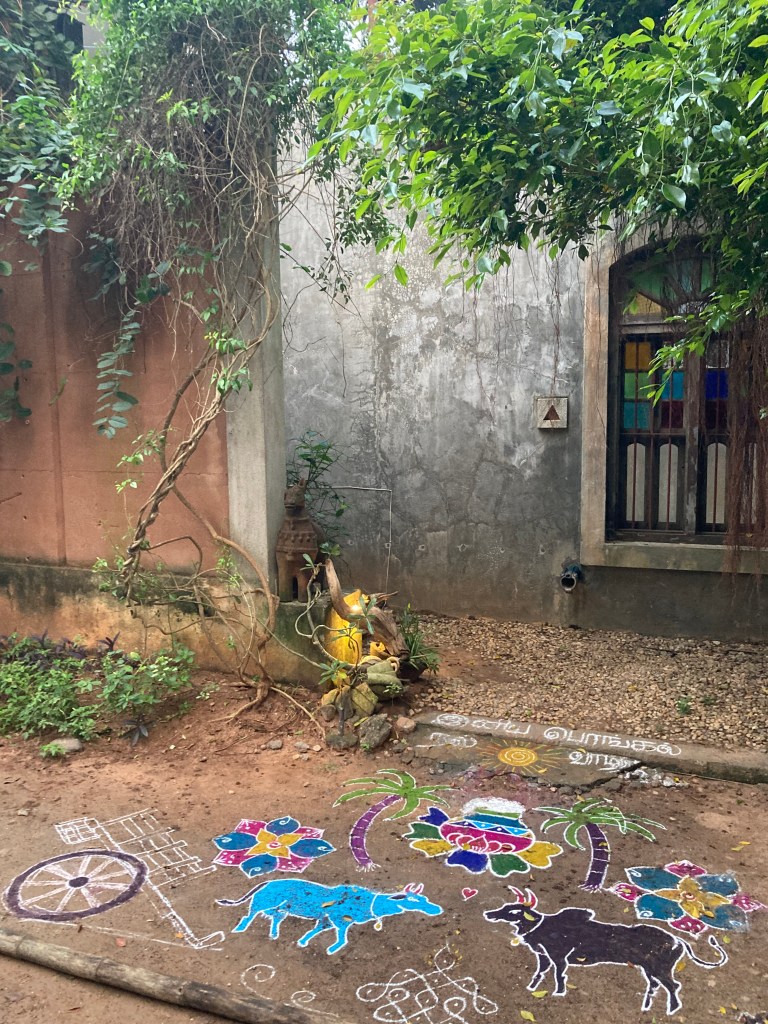
Sunrise cycles bring a deep bow of gratitude to my father for inspiring the early morning worshiper in me as the colours of Pongal are laid out on dawn-drenched doorsteps in honour of the hope of abundance … that may never come for some. And I reorientate too to the perception of abundance; the value placed on it, and its very nature. My e-cycle eats my trouser leg. I stop to eat another mango. Permission spills out here. I drink it with my morning coffee. I dress it like a Pongal bullock and dance around a Pongal pot dressed in a sari of possibility. I merge temporarily with the me who was here twelve years ago and I slip timelines … and everything I imagine these next three months to be, fall to shreds in the throes of trance.

I listen to Joseph Goldstein on mindfulness. Would he fail me, I wonder, if he knew I listen whilst running in the forest. I overtake a couple on their e-cycles. My body is strong since Chinese cupping and Moxibustion but my gut goes into crisis as it no longer holds anything. The couple return the challenge. I up my game, drawing on reserve fuel, motivating purification as my being busts open and shatters apart less integrous cells that can then be expelled from my body. Healing only fully happens when the system is empty.

I am empty. And full. Both And.

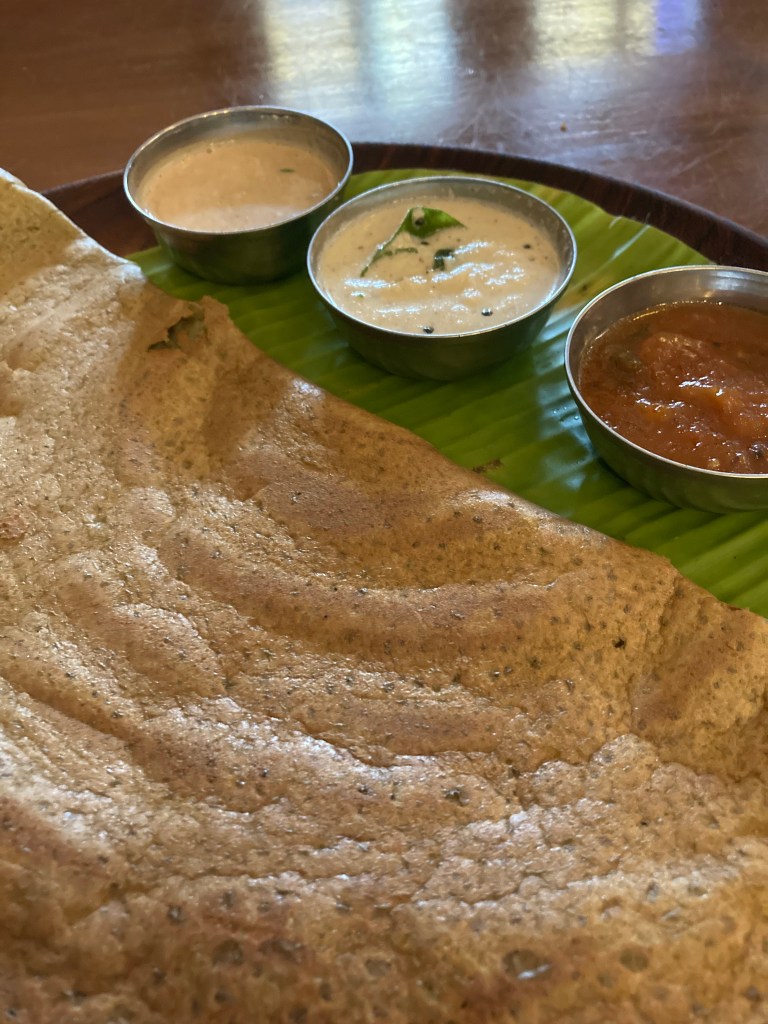
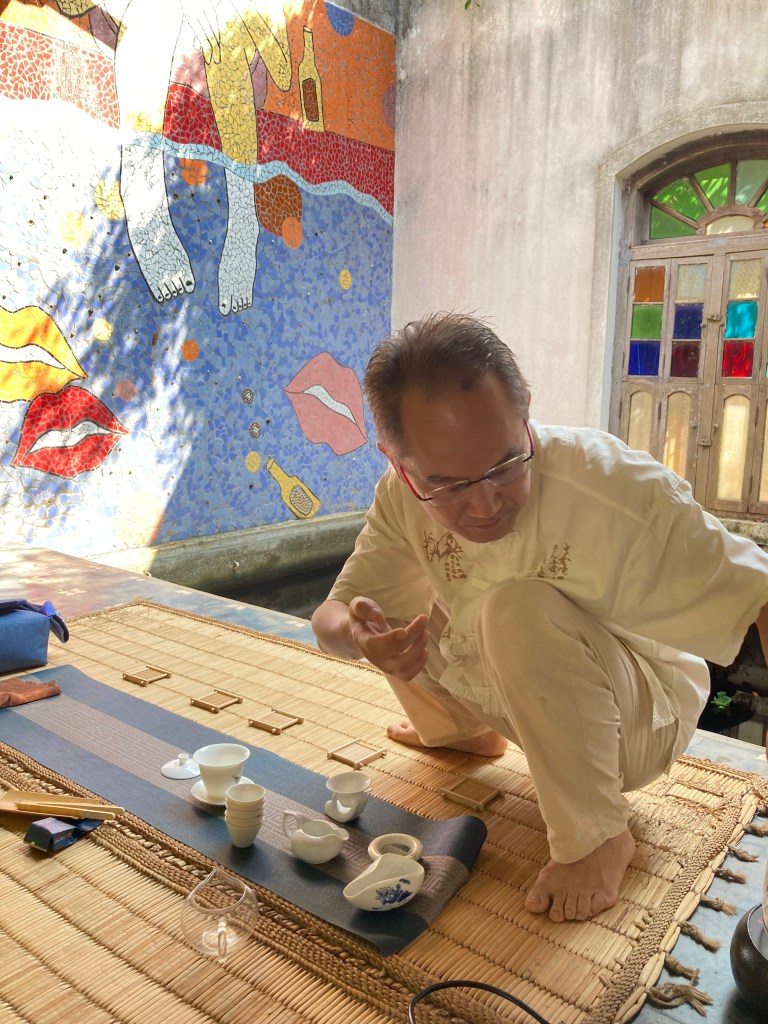
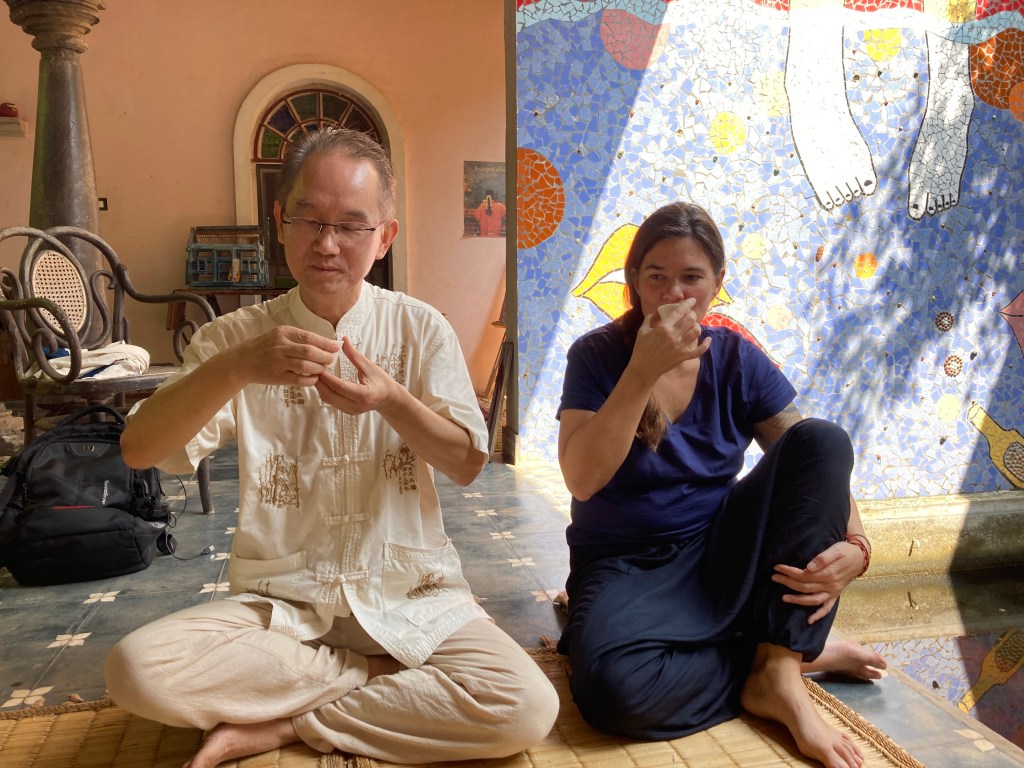
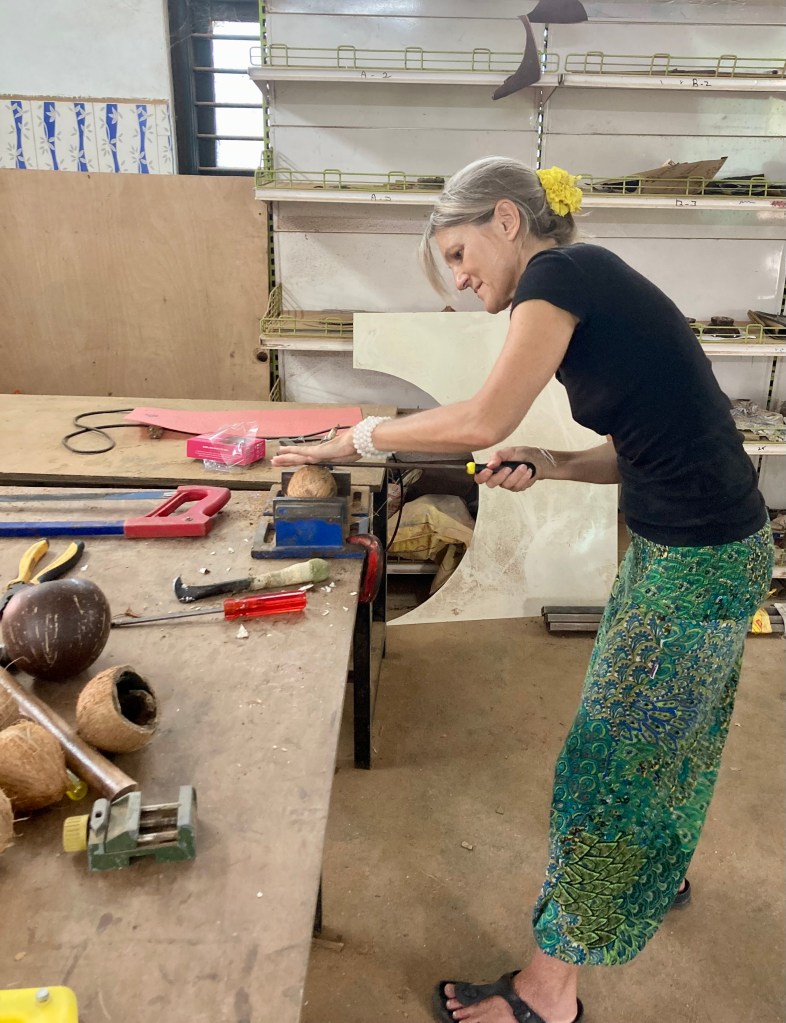
I make coconut shell espresso cups for my new Aeropress and learn face yoga; I drink copious amounts of Marc’s Coffees and invite Chun to facilitate a tea ceremony beside the koi pond at 4 East Coast Home, my new digs; Yashi’s serves up my favourite coconut cappuccinos and Mohanam prepares special thalis I consume whilst writing content for their new sustainable business website. I don’t skip a day without fresh fruits and green coconuts and I am resetting my system physically, emotionally, mentally and spiritually. Travel—and India specifically—has the capacity to both shatter my heart into pieces and break it wide open.

I don’t need red sequin shoes. I don’t need a false guru. All I need is the heels on my feet and the capacity to swiftly tap them together three times. And I am home; not to a physical space but a place within myself I no longer want to escape.