The 5 Symbols of the Camino de Santiago, Part Three: The Yellow Arrow

It may look like the same route as the hundreds of thousands of pilgrims before you yet it is different for your walking it. A pilgrim’s unique footprints make for a unique pilgrimage. 

The Yellow Arrow is a sign of reassurance that one is following one of the routes on the pilgrim’s way and is an iconic symbol of direction in one’s life as well as ancestral direction and rites of passage—pointing out A way which is different to THE way. 

When finding and following these markers it’s a reminder to honour those who have come before. There is a ritual to walking a path that many have taken before, honouring them for carving the way and then honouring oneself for creating one’s own journey from the way. There are many paths leading individuals back home to themselves.

A well-trodden path is still the path untaken until one actually takes it … and then one gets to make it one’s own. It is important to get lost in order to find my way and there is a particular practice of non-judgemental observation that comes with the acceptance of this. I feel it’s important to find myself in a place so unfamiliar that I am challenged to work out how to come back to myself or to accept the new place in which I find myself.

Every part of the entire universe is already right here in this one moment … this one step. There is no manifestation magic in life; it’s all about showing up and placing each foot down with attention and intention. In alchemy it is the third stage in the process, Citrinitas, which is the stage of education before Rubedo, the stage of transformation.

The present moment is your refuge, and this is your home … each footfall brings you back to your self and each self that footfall brings you to is changed because of the footfall. Each contour is as unique as the contours on each individual’s thumbprint; each arrow perceived as just a subtly different shade of yellow; each vista viewed with new eyes; each drop of dew a different prism of light. 

Stepping into each moment builds awareness of what’s in the way, where the path is leading, how open you are to your intuitive GPS, when to follow outside signs or inner cues, when to change direction etc. Trust in self appears in the showing up without knowing where the path goes but recognising that no matter where it goes it is going somewhere and it’s ok to adapt along the way. It’s impossible to be ready for every eventuality before a journey but it’s possible to be prepared to be resilient enough to figure it out on the way. To be able to flex into the curves and detours of any journey is a skill we can develop through recognising that there are over seven billion unique humans and, therefore, over seven billion unique paths.

Questions to ask yourself:

  • Where did I lose my way?
  • How was I able to find my way again, find a new way, or ask someone to guide me?
  • In the moments of getting lost how did you recalibrate to a new way by asking for guidance?

You can follow, support and share my Walking for Mental Health fundraising campaign on BackaBuddy. All my socials can be found on LinkTree.

The 5 Symbols of the Camino de Santiago, Part Two: The Walking Stick

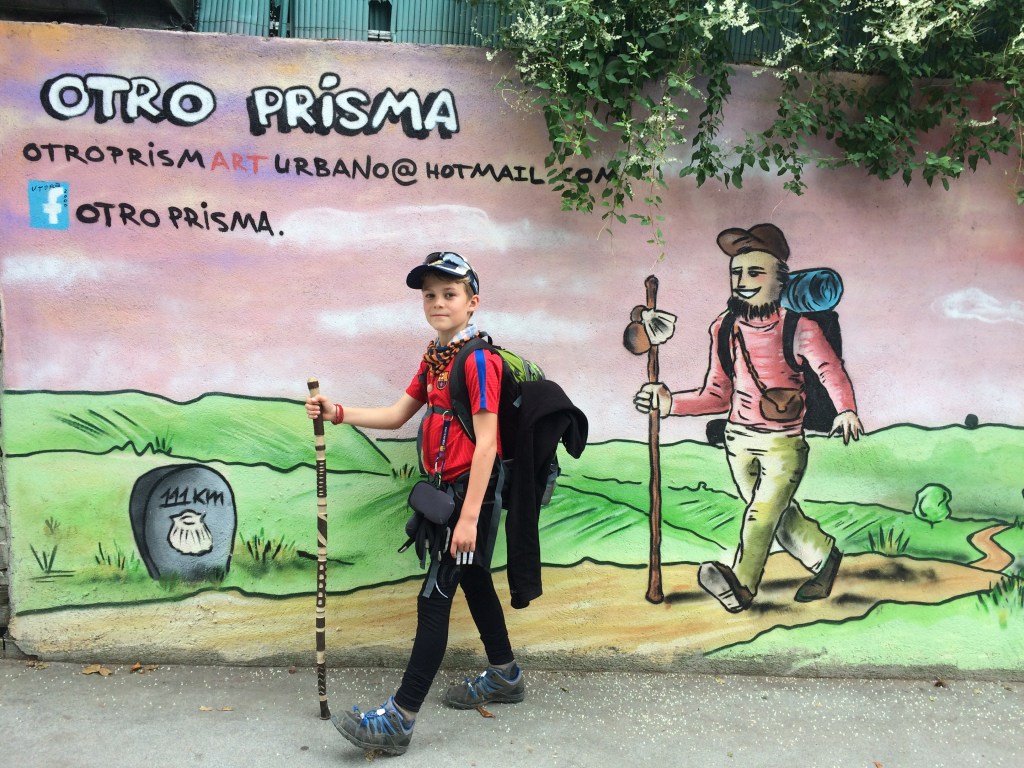
The Walking Stick is a symbol of those people in one’s life who assist in upliftment, encouragement and forward momentum. Having an emotional, physical and spiritual staff to lean on can help traverse tricky terrain.

I don’t walk with poles or a walking stick—in fact the few times I have used someone’s for a difficult crossing or steep downhill, I have fallen. This indicates to me that I need to become more familiar with asking for support. My innate tendency is to always be self supporting and to hold others up. This can be to my detriment if I can’t equally find the people and resources to support me in supporting others.

A Walking Stick can be seen in the negative light of a crutch and using one can be seen to highlight one’s disabilities. It is, therefore, imperative to give this an archetypal symbology that encourages its use. The sense of outreach in difficult times is so key to reducing suffering and restoring well-being. 

This current campaign to walk 1,000km to raise awareness for mental health and suicide prevention made me extremely vulnerable in the asking for support and extremely disappointed. My lessons around support are to lean in only when the support is actually there and being mindful of expectations of it, without using the lack of people believing in me to snap back into being 100% self supporting again.

When you carve a walking stick that ultimately provides support for your pilgrimage, it is like an analogy that can translate into the care and love offered to and infused into another human being that ultimately become the food that fuels that individual to be the support you one day may reach out for.

The pilgrim’s Walking Stick is a symbol that young, able-bodied people also make use of this often necessary tool for of support and that there is no stigma attached to utilising it, whether walking 5 or 45 legs of the Pilgrim’s Way. Using a Walking Stick can be a practice of mindfulness and gratitude—a way to honour the self and the body in recognition of its strength and also acceptance of its fallibility.

It holds the intention and reminder that there is always support at hand and it will challenge a different response when either needing to ask for or accept the offer of help from others. I can lean on something/someone temporarily and it’s ok to then lay it down, until needed again, without a) feeling obligated to be enslaved, and b) depending on it always being there.

Questions to ask yourself:

  • What held me back—cognitively, emotionally, somatically—in asking and/or receiving a hand of support today?
  • Who are the people in my community, tribe who are my walking sticks in life and how do I honour these people more by being receptive to their care?

You can follow, support and share my Walking for Mental Health fundraising campaign on BackaBuddy. All my socials can be found on LinkTree.

When asked, ‘Why …?’

When asked why I chose the Camino de Santiago for this mission and to raise awareness for Mental Health in Suicide Prevention month, the answer was clear:

I have walked so many varied paths all my life, always with this libido driving me towards something there … yet not yet visible. There has been this calling, sometimes subtle and sometimes so intense it has brought me to my knees in prostration and frustration. And yet I have walked and walked and walked through injury, bad climate, distress and, most importantly, a deep knowing that there was something I was walking towards.
Raising awareness for mental health; de-stigmatising conversations around suicide, trauma, grief and loss, and educating people with tools and techniques to recalibrate around adverse life events and debilitating emotional distress are what I was unwittingly walking towards on all my paths.
My paths have been in psychology, investment banking, social development, coaching, meditation, mountain guiding, Vedic scriptures, travel and trekking, writing, creating, consulting, healing and helping.
In short, Walking for Mental Health is my very own Camino de Santiago

With two weeks until departure for Spain to walk 1,000km whilst offering my skills, gifts, wisdom and work freely to fellow pilgrims on their own unique paths to their mental, emotional, physical and spiritual goals, I am reaching out once more for support for my campaign, which is almost 50% funded and which still needs over ZAR 20,000 to make it possible.

If you are unable to make a donation, please consider sharing the campaign with those who resonate with my vision and mission and please note that there are donor incentives for those who would like to experience my work.

To contribute to Walking for Mental Health you can click on my BackaBuddy link:
https://backabuddy.co.za/campaign/walking-for-mental-health
or find all my socials, including how to follow my journey on YouTube, by clicking on my LinkTree:
https://linktr.ee/Walking_for_Mental_Health

Being a donor and supporting me to walk my talk means you become part of the journey of support for whomever I coach along the way. You become part of the solution.

Walking for Mental Health

I have been a quiet activist for most of my life, starting as far back as pre-teen when I thought donating my pocket money would end world hunger.

I have also been a not to quiet activist, getting hate mail when I was feeding hundreds of people made homeless in the settlement in Hout Bay.

I’m not so naive that I expect this campaign or even the work I do to change the world; what I do know though is that if I die a pauper having helped just one person survive the darkest moments of their life then that is a rich life indeed.

What it means to live well means different things to different people. For some it is accumulating money, status and possessions and for others it’s about relinquishing such things. Some people require luxury and some need simplicity and there is no right or wrong. The key is integrity, authenticity and self-reflection on the meaning that is being lived through you and how that motivates you to purposeful living.

For many years I accumulated as much as possible feeling my prior years life as a sensitive activist was washed away by the perception of a waste of time.

My years in investment banking and consulting was like putting a metal cast on a grazed knee—it was the ultimate burden that almost killed me by first breaking the spirit of who I was meant to be in the world.

As I stripped away the layers and left myself exposed to those who couldn’t understand my giving up my feathered nest, I recognised that behind the criticism of many was that longing to also find meaning … and the intense and debilitating fear that often prevents it.

I have shadow boxed with depression and addiction my entire life. A recent confrontation with depression, addiction and dysfunction has helped me address the relationship these have with connection, childhood trauma and hyper vigilance around personal safety, boundary violations and feeling the need to give myself away in order to be accepted … to exist even.

Depression and addiction have deep roots and, although I have done decades of work on my childhood traumas (neglect, abuse, violations, hyper-vigilance and a lack of safety), as well as adult traumas (rape, relational and familial abuse, breakdowns, grief and self harm), I have to be vigilant. Sometimes my only saviour is feet in running shoes on mountain trails. Some call that an escape, others call it an addiction. I call it survival, serenity, self care. Running and hiking have always been my medicine; my means to process and progress on an ever-deepening spiritual path. Writing and story telling are my other elixirs. So, when looking for a passage through this mental health crisis, I recognised the Camino de Santiago as that tool that could save my life.

Grief is not always about losing someone you love, it can also be about losing aspects of self; it can also be mourning the loss of a person still alive and grieving the person you could have been if things had only been different.

My immediate aspiration is to walk 850 to 1,000kms across Spain from 17 Sep to 4 Nov ’25 whilst advocating for Mental Health with the sharing of tools & techniques with fellow pilgrims, to create a new narrative through coaching and story telling. I will also offer craniosacral therapy along the way.
My long term goal is to use the unique combination of my qualifications, wisdom and experience to initiate teenagers from disadvantaged communities into nature therapy (using my years of experience and studies in social development) as well as corporates (using my long history in Investment Banking and Consulting).

“My ugliest parts, when met with mercy, can become my greatest assets.” ~ Frank Ostaseski

My work is not to help people live the kind if life I have chosen to live; it’s to show them that they have their own way and to help them uncover and/or develop the tools that will enable them to find the path that will appear only when they take that very first step. It can be overwhelming deciding (in the head) which of the myriad paths to take until a felt (in the heart) sense is realised.

To support me to support others whilst walking the Camino de Santiago, please click on the link to pledge your support:
https://backabuddy.co.za/campaign/walking-for-mental-health
I offer donor incentives in the form of vouchers for specific minimum donations.

The amount you donate will contribute to my pilgrimage to giving the topic of mental health the bandwidth it needs and supporting me to support others as they too walk to wellness. Together we can remove the stigmas attached to the topic of Mental Health and support people in their times of crisis and healing.

We begin so we can end and we end in order to begin again.
Let’s get people walking their talk to better mental health.

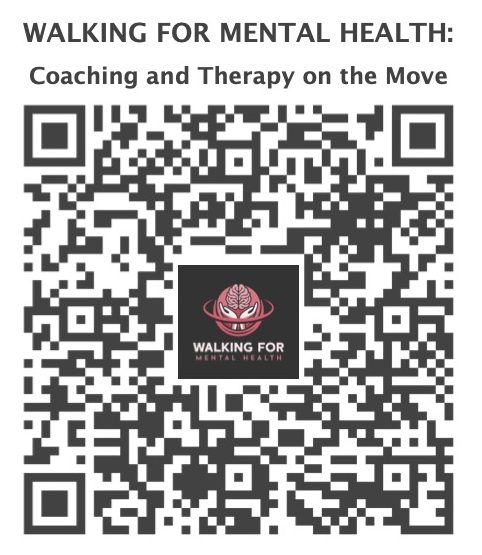
Scan this QR code for my LinkTree,
which contains all the relevant links for you to follow, support and share the campaign
as well as the work I do both here and abroad.

Four: The Peak of Pilgrimage

Mercurial Gemini with a strong intellect and speed, I get myself so tied up in knots over labels and judgements; flummoxed by the dangerous new age bullshit of either being in my head OR in my body. My pilgrimage this past year has almost broken me; taken jackhammers to my psyche trying to understand where the unique intersection is between the paper doll, the shadow and the self; made me sick wasting energy justifying who and how I am … on blending two parts of myself that were never separate.

“Now, about that word authentic. It is related to the word author—and you can think of it as being the author of your own self.” — Marion Woodman

Being authentic and spiritual makes me the more real, not the less. It guides me on those internal spiralling pilgrimages down passages of grief and awakening. I touch into every part of me that is also a part of you and therefore a part of everyone and everything in the universe. I can’t hide or deny any aspect of myself. And so I write and I walk and I journey to the places most are afraid to go; places I am mostly also afraid to go.

Slightly Chilled. The name of a guest house I pass on my walk to find real coffee. Nescafe signs send me away. Coconut time. I walk to the river and put my feet in the coolness. Vegetable Garden House is Super Chilled—the family, the garden setting, the beautiful young travellers I meet over delectable Sri Lankan breakfast dishes and weird Sri Lanka coffee.

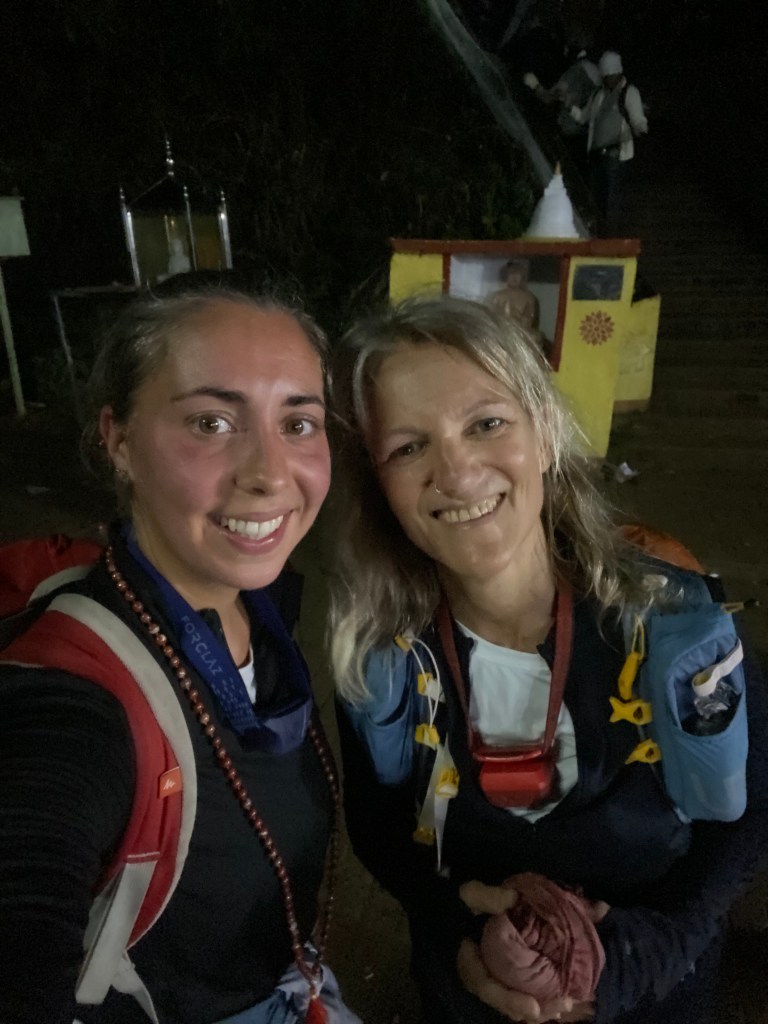
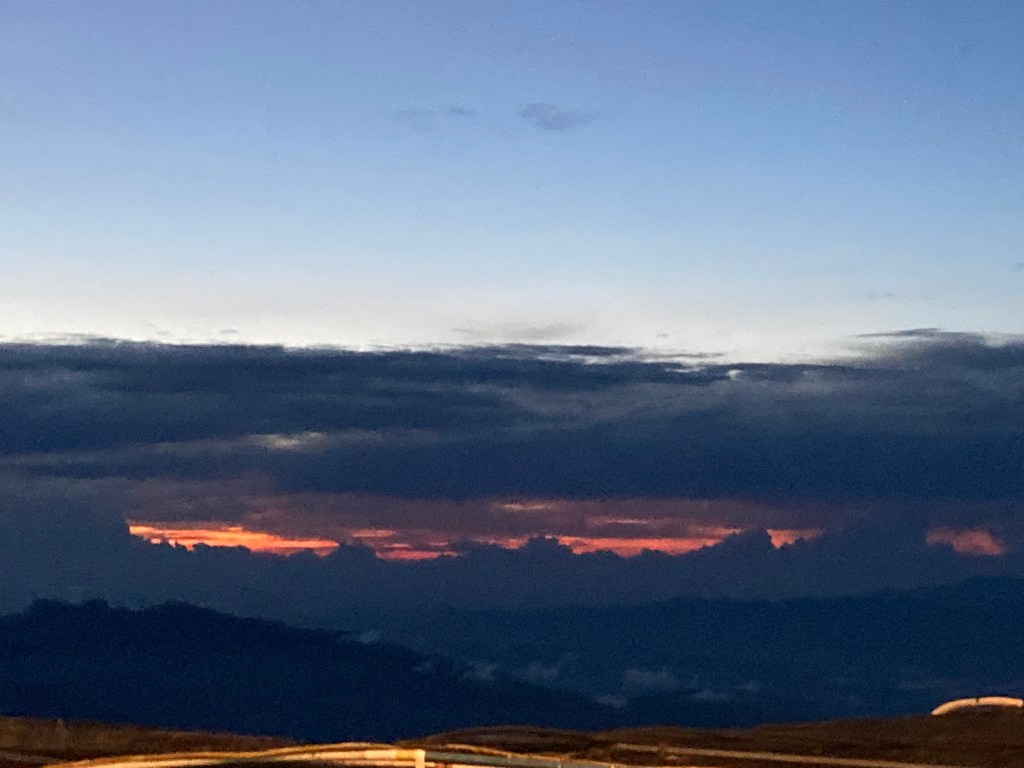
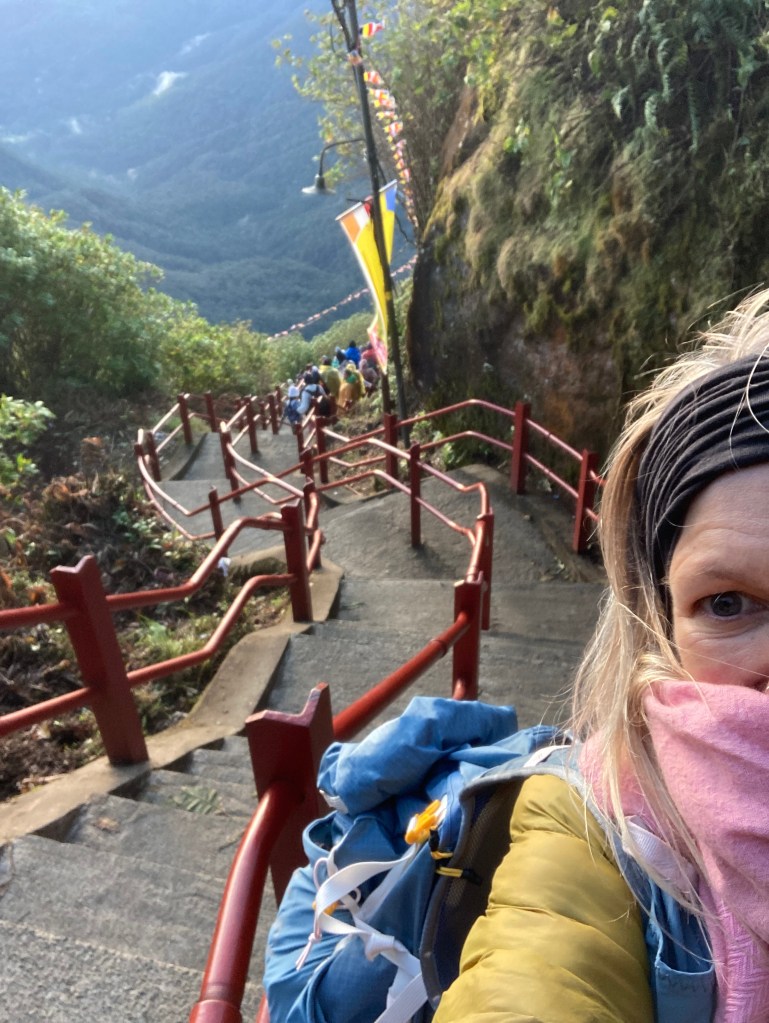
I wake before the three alarms I have set. It’s 1h40. I am dressed in full hiking gear when I climb into bed at 8pm. My fast-pack is loaded with every warm item of clothing I brought with me, including the pink shawl (the Diana I take on every pilgrimage), a kikoi, extra socks, an entire change of clothing and merino wool gloves. Geared up with head torch and rain jacket, I emerge from my room to the sight of a woman also kitted out for the climb. Her name is Cami, she’s from Paris and it’s her 32nd birthday. It’s hard to imagine I’m twenty years her senior. I feel 35 again, meeting young travellers on their first round of adventure. I get the sense I am being appraised with a measure of curiosity; they are not sure which bracket to place me in as I am the age of the mothers who are in the process of making home and being normal.

Walking this path often means walking alone. And alone isn’t about being without people but without the capacity to articulate my sense of self. Relationships fail for me because I attach to an ideal based on what the world wants from me rather than what I myself want for me; I attach to the illusion of what it promises despite knowing that intentions are generally to ‘fix’ my rabid self reliance in order to make others feel less conflicted and more comfortable with their own erroneous attachments.

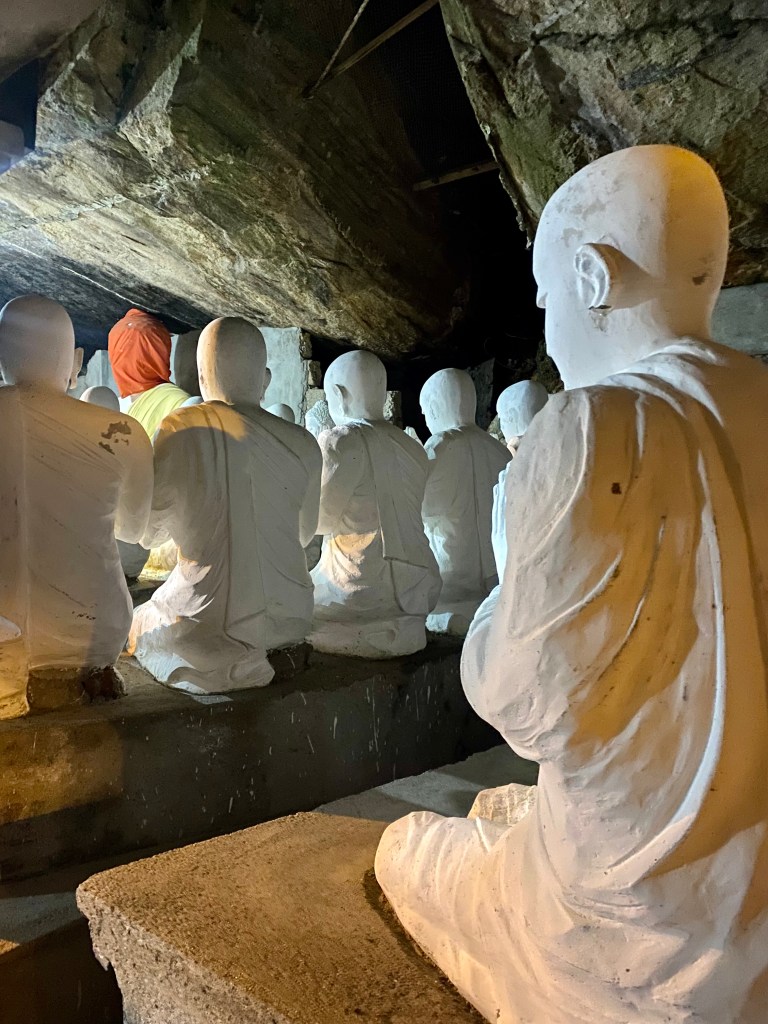
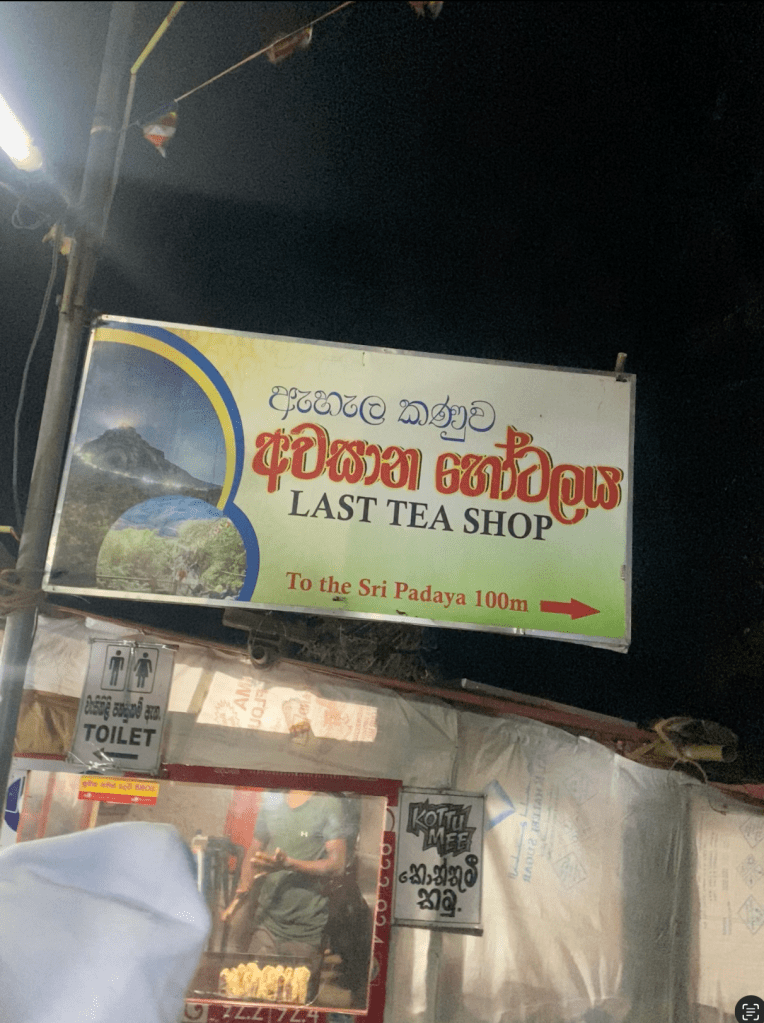
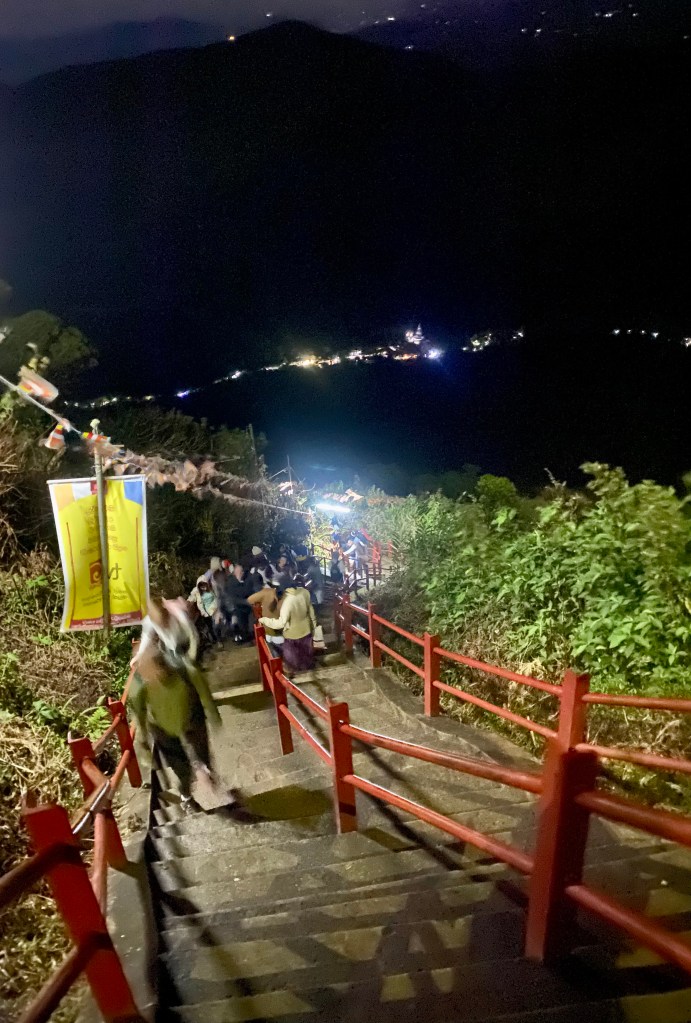
Most hikers in Cape Town know the Newlands Forest 400 steps. Add another 5,100, throw in a gazillion tons of concrete, hundreds of neon lights, tea stalls, sweet stalls, Buddha statues, snack bars and innumerable walkers from as old as ancient and as young as infant. It’s a lot to take in. I have the intention to do two nights in a row up SriPada. I am delusional.

Like the star at the top of the Christmas tree, the cluster of neon lights marks the end point of the climb, where the foot of Buddha is believed to have dented the top of the hill. I am initially captivated by the continuous row of lumens lighting up the path until I recognise the reality and the altogether fabulous absurdity of it all. A monk ties a white string around my wrist with blessings for the journey and, similarly to the Camino de Santiago scallop shell, I am branded a pilgrim and given kudos for my commitment.

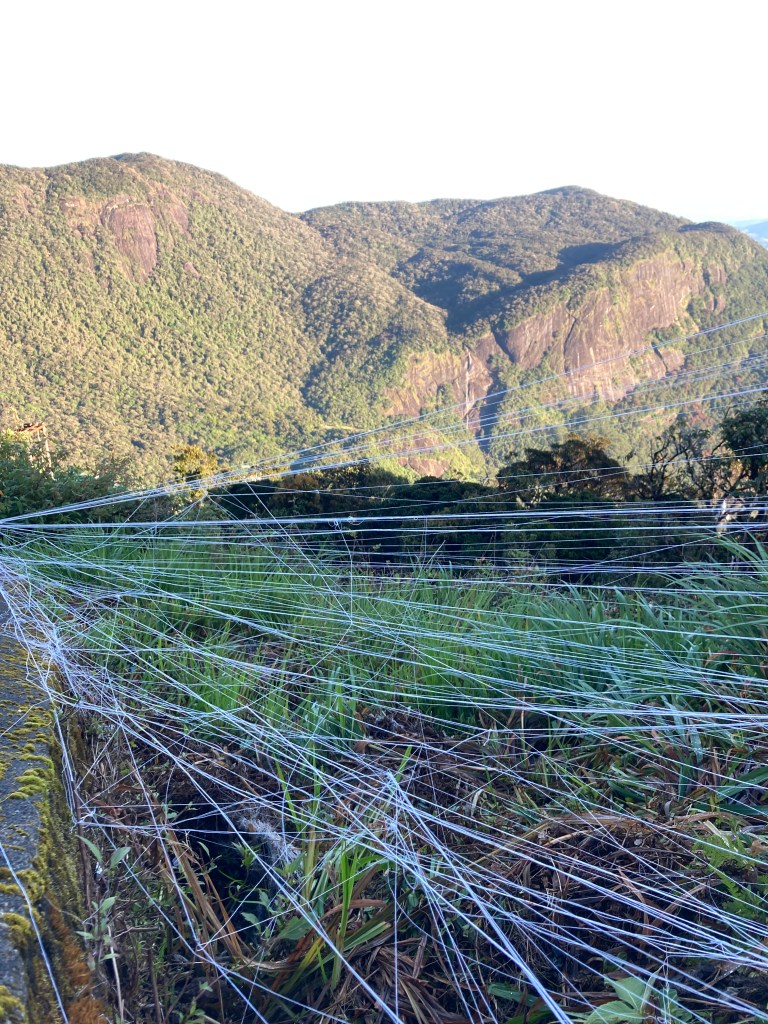
I navigate new pathways and pave new neurological networks. Like the silk of the spider’s web or moth’s cocoon, the white pilgrims threads create initiation networks, a semi-permanent anchor on the railings. I lay paths that others may follow, not because I know my way but so others may know it’s okay to not know. There are no solid  lines on this map. Only hyphenated. A dot-to-dot puzzle. This is my Sadhana.

People sleep where they sit. A young girl walks holding her mother’s hand; sleepwalking. A man walks barefoot; it’s his 15th time to the Peak. “Is that a spiritual thing?” asks my walking companion. “No, my boots got too heavy”, he replies, focused fully as he places each footfall tentatively on the gnarled concrete. But I feel differently. That kind of pain can only be a spiritual experience. People carry babies and toddlers, people sing to encourage each other, and the elderly use the  railings to replace worn out knees. Babies cry; some adults too. It’s an endless river in flow, night after night after night. The same yet always different.

Everything in life is pilgrimage. Nothing we do or say or love is unique. Yet, in pursuit of being individual … special … we try to carve our own way and, in doing so, fail to recognise the struggle, the value, the pull, of all the millions that came before. And without proper ritual to honour the trajectory of sameness, we ultimately get lost.

I lie awake on the second night in the shadow of SriPada imagining the thousands more trudging to the peak, and I know that as weird and whacky a pilgrimage it is, I am bound to do it again … many times. People who judge me for my atypical free-spirited escapades also follow me vicariously; afraid to step into the groundlessness of the abyss … smothering themselves instead in the illusion of hoarding for something that never comes. A guru tells me that I’m on the right path when fewer and fewer people understand me. 

I travel solo so I can disappear into a framework of existence that doesn’t require justification or proof of my being. I travel solo to untether myself from these insidious and relentless chains curtailing my capacity to simply be. I travel solo so I can re-understand myself.

Courage is my currency.