
Grief is not weakness or frailty; it is the weight of the love that now has nowhere to go.
There are some wounds that aren’t apparent on the surface of the body but that can hurt more than anything that bleeds. Grief is not always about losing someone you love, it can also be about losing aspects of self. It can be mourning the loss of a person still alive and grieving the person you could have been if things had only been different. Abandonment is also a micro death.
My range of qualifications includes Psychology and Coaching and, although I bring these into my grief and trauma work, I understand the insight that comes from talk therapy needs to be complemented with movement, breath and elemental resources found in nature and nutrition. I also understand that somatic work can trigger deep unresolved wounds, which means a traumatised individual needs a safe holding space with a professional when beginning a yoga, meditation or prana practice.
There are no hierarchies here; everyone has their own scale of 1 to 10 when impacted by loss, grief or trauma and everyone has a unique set of resources and capacity to process.
Through a combination of:
🌀 light touch therapy
🌀 coaching
🌀 trauma release
🌀 meditation
🌀 chanting
🌀 asana
🌀 guided nature therapies
🌀 retreats and grief circles
we allow the trauma, loss and grief to be present with the intention to:
◦ calm your Central Nervous System;
◦ find a new set point from which to operate without feeling under threat;
◦ create a new recalibrated relationship with it so it doesn’t hijack your life;
◦ let go of the need to let go and find a way to let it be;
◦ access resources to continue the deep healing on your own.
Accumulations of repressed memories sit like a time bomb in the cells of the body acting like a videotape that is replayed whenever stimulated. Animals have a built-in survival mechanism that instinctively causes them to stop and shake after being chased by a predator or hit by a vehicle. Humans, however, are commended for negating their traumas, ignoring their grief, and shutting down natural instincts to shake, cry, recalibrate and recover. The consequences of storing our entire lives within our bodies and our minds can be anything from depressive to catastrophic, as repressed symptoms get compounded in the depths of the psyche and cells only to emerge as what is never just a random illness or disease. The release of cellular distress is the fundamental focus for harmonious integration of body, mind and psyche.
Jane Appleby
Etymologically, grief means heavy. As with trauma, grief is not something to be fixed. Both trauma and grief are responses to events or situations and are somatic and mental consequences of certain conditions (either once off or repeatedly, as in cPTSD) that you haven’t had the opportunity to process. When healthy responses are overridden, the brain learns to compensate and adapt to less healthy response patterns based on dysfunction and dysregulation. Working with surface-level symptomatology can bring relief but the conditioned response can only be reprogrammed with access to an equal measure of conscious resourcing. Longterm resolution comes only by going deeper into the system.
Thank you for your healing of me, I can finally sleep through the night without pain!
Gavin Hudson
The only real custodianship we ever have is of our own sovereign beings, yet we are conditioned to believe we must outsource this to a whole range of so-called experts and medications. Having said that, we all need to be heard and held in our hardship and often simply need a starting point to acknowledge the depth of what we are navigating so as to find our own phenomenal and innate healing and wholing capacity within. I have done decades of work on my own traumas, grief, addiction and dysfunction and now utilise my wounds as gifts to advocate for wellness through somatic release.
Anatomical Landmarks:
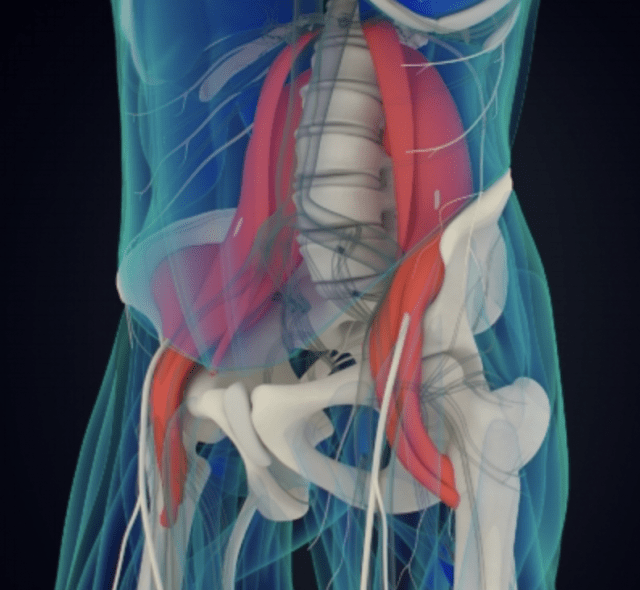
The psoas muscle (in the impression above in red) is the only muscle that attaches the spine to the legs and, as such, is critically important in the physical body’s instinctual nature to kick (fight) or run (flight). But part of the sympathetic nervous system response to threat is also to freeze and this also has a direct effect on the psoas muscle as it traps the stress right in the centre of the body. The more tension that gets stored in the psoas, the more physical pain emotional blockages, mental fatigue and breathing issues become apparent. Because of the huge impact this muscle has on all the chakra bodies and nadis/nerve highways, it has become known at the seat of the soul. And because of its deep-seated position in the body, the only way to release it is through targeted modalities that are focused on accessing the imprinted patterns in the body and mind that have built up over time.
Adjacent to the Hippocampus is a small almond-shaped structure in the centre of the brain called the Amygdala. The Hippocampus is associated with memory formation and the Amygdala is responsible for the processing and storage of emotional memory. When the brain is in a constant stress mode, there is a cascade effect through the body, which has been conditioned to keep still, hold things in, be pragmatic, not get emotional, and stoically continue as before. Beyond any memories of actual events, traumas or illnesses, this behaviour sends a message to the brain that this is normal and prevents the brain from resetting. The Amygdala is now primed for an incongruous response and the body is in a state of fight or flight … trapped in an unconscious pattern ready to play out inappropriately, and perfectly placed for disorders such as anxiety, depression and addiction.
Shaking Medicine:
When anything breaks, heat is generated. This is the premise of illness, change, breakdowns and breakthroughs. When anything breaks, trembling is generated. This is the premise of shaking medicine. The pulling apart of opposites creates the tension required for a third possibility to arise. Within all dualities lies the breaking apart as a pathway to find wholeness. In healing, energies may shift and course through your being in ways that make you feel unfamiliar in your own body. Allow it all to happen–the pains, sweats, shakes are there as messengers to remind you that you have the courage and capacity to heal. We sometimes have to break open to complete annihilation before we can heal.
Outcome:
We work from the inside out. When the subconscious mind heals, it allows the nervous system to relax, and when the nervous system is relaxed there are less erratic signals, and when there are less erratic signals, the endocrine system doesn’t need to be in a state of fight or flight. Therefore less cortisol and adrenaline; less inflammation and disease. This new set point brings you into a better resourced state of being that isn’t necessarily free from anything, yet is now equipped to hold the process with love, patience and presence.
Within all of us is the freedom to rise to a higher state of being.
See the Glossary for definitions of terms used.
 WELL WORTH BEING